Monday, April 30, 2012

The Basignani Piazza

Well, the outdoor wining and dining area we long dreamed about is finally a reality.  For years we here at Basignani have wanted a more permanent and substantial place for our customers to enjoy our wine al fresco, and our beautiful new patio area is now ready for the summer season.  If you have visited Basignani Winery in the past, you may remember the sloping grass space - which was often covered by a tent - between the tasting room and the brick pizza oven.  That area has been leveled out, covered in crushed blue stone, and highlighted with steps of granite and natural stone walls.  The green circus-striped relic that shaded the grassy area for years (and was beloved by our founder), has been replaced by a crisp and clean white tent. This new tent covers and shades the larger lower portion of our new two level patio area.  After much discussion and planning, we are very pleased with the final result.

You might be surprised to learn, that even with a small family owned business like Basignani Winery, it is often difficult to agree on what needs to be done and what changes should be made. Even though we aren't a large corporation, and don't have to answer to shareholders or a board of directors, the involved family members often have differing opinions on what changes the winery should make, as well as how and when to make them. We needed to consider how we were going to level the area - cut into the uphill side, elevate the downhill side, or some combination of the two.  We had to decide how large the area would be, how it would integrate with our current traffic flow, and what materials we would use.  We had to find a professional to help us with the engineering and design, as well as a stone mason to handle the foundation and block work.  Thankfully, we had Ben Mentzer and Bert Basignani.  Ben is Elena Basignani's husband, and is responsible for most of the physical operations of the winery.  Ben has a background in both contracting and landscaping, so he was the perfect man for the job.  Of course 'the boss' Bert Basignani has over 40 years of construction experience, so that was also advantageous.  While the two of them sorted out the structural details, the rest of us chipped in with ideas and opinions about the aesthetics.  Ben and Bert eventually found landscape architect Jack Leonard from JGL Design Associates to survey the ground and draw up a plan, and then decided on Vachino Masonry to handle the foundation, block and stone work.  We were ready to begin.

We considered using concrete block for the walls, as the cost would have been significantly less, but 'the boss' insisted we use stone.  Some decisions at Basignani aren't democratic, this was one of those decisions.  As is often the case, there is no substitute for experience.  Even those of us skeptical about the increased cost now realize that Bert's edict was absolutely correct.  We used a combination of Butler stone salvaged from past construction projects and Black Rock stone sourced from the property.  On seeing the finished product, we all realize it couldn't have been done any other way.  The granite steps were also salvaged and sourced from left-over material already on the property, Ben jokingly said they were 'a joy to work with'.  Another decision we faced was whether or not to put a railing around the raised lower level.  Our initial feeling was that it wasn't necessary, but as the project developed and we were able to better envision the finished product, we realized it would be a nice addition.  We think the wrought iron railing provides a comfortable feeling of enclosure and is aesthetically pleasing as well.  As we neared completion, a last cosmetic question remained - what type of tent should we use? On this point, Bert acquiesced to the democratic process.  He would have preferred another striped tent, but allowed us to go with the simpler covering the majority of us favored.

All in all we couldn't be more pleased with how the area turned out and are looking forward to introducing it to our customers this season.  We hope that for years to come, our guests make memories and enjoy good times and good wines on the Basignani patio.  Our intention is to make the area available not just for our winery events and during the hours the tasting room is open, but also to offer it by hourly reservation for parties and events.  We want to make it possible for others to celebrate their special events and enjoy our beautiful natural surroundings.  Which brings us to the last decision we faced and the last issue related to our new outdoor patio area.  What do we call it?  We debated "The Courtyard" and "The Piazza", or maybe just "The Patio" at Basignani.  I wouldn't say the debate was heated, but it certainly generated some spirited discussion.  Eventually, in light of our Italian heritage and memorable times spent in small Tuscan towns, we settled on "The Piazza".  Webster's Dictionary defines a piazza as - 'an open square especially in an Italian town' and 'an arcaded and roofed gallery'.  We consider the winery our little town, and we hope "The Piazza" will make visiting us even more memorable.  By whatever name, the goal at Basignani remains the same, to provide the best possible experience and the best possible wine. We hope you will be out to enjoy it with us soon.

Monday, May 2, 2011

Cinco de Mayo...with a twist

Cinco de Mayo may be traditionally celebrated (in the US) with margaritas and Corona, but this year my friends and I have decided to try something a little different: Sangria.

Cinco de Mayo is a Mexican holiday commemorating the Mexican army’s victory against French forces at Puebla on 5 May 1862. It is not, despite common misconceptions, Mexican Independence Day (which is actually celebrated on 16 September). Many estadounidenses (literally translated as United Stateseans) think of Cinco de Mayo as a day to celebrate Americans with Mexican heritage, much along the lines of St. Patrick’s Day or the Chinese New Year.

Though Spain and Portugal are the two countries most commonly associated with sangria, this wine-based punch is also served in many South American countries (as well as Mexican restaurants in the States).

To celebrate the end of our final spring semester (which happens to coincide nicely with Cinco de Mayo) my roommates and I are resurrecting the Taco Thursdays that went by the wayside rather quickly as our schedules got busier and busier back in September.  

Taco Thursdays entail:

**Taco Filling:
1-2 red onions, diced
6-12 peppers, sliced  (depending on the number of RSVPs)
Other vegetables (squash, eggplant, etc) as desired
1-2 cans Chickpeas, boiled
Taco Seasoning (pick your favorite kind…mine is the Simply Organic Fajita Seasoning...and follow the directions on the packet)
(Sautéed ground beef or boiled, shredded chicken can also be added)

Sautee onion in a little olive oil until lightly browned, then add peppers and other vegetables. Add taco seasoning, water, and chickpeas (drained). Simmer until thick.

**Spanish Rice (I’ll admit, I use a packet)

**Refried Beans (microwave with salsa and cheese)

**Sour Cream

**Salsa

**Cheese

**Guacamole:
4-6 ripe avocados (slightly soft, but not squishy), mashed
Fresh tomato, diced
1 red onion, diced
Cilantro, garlic, salt, pepper, and lime juice to taste

**LOTS of friends, food, wine and conversation (hopefully enough to spill onto the balcony!)

To this particular Taco Thursday, we are adding Basignani Sangria.

Traditionally, sangria is a young red wine blended with triple sec or brandy, orange juice, and fresh fruit (oranges, apples, lemons, pears, berries etc.). At Basignani Lynne makes two sangrias, a white and a red, with the Elena (a Seyval blend) and the Marisa (a blend of Foch, Chambourcin and Chancellor). I will be making both on Thursday to appease taste buds of the red and white wine drinkers. I can’t wait to find out which one tastes better with our tacos!

**Red Sangria

1 bottle Marisa
1 c. O.J.
1 c. Club Sprite
1/2 c. Sugar
1/4 c. Triple Sec and/or Brandy
Assorted sliced fruit (1 lemon, 1 lime, 1 orange)

Mix together and serve over ice.

**White Sangria

1 bottle Elena
1 c. White Grape Juice
1 c. Club Soda
1/2 c. Sugar
1/4 c. Triple Sec and/or Brandy
Assorted sliced fruit (1 lemon, 1 lime, 1 pear, 1 peach, strawberries)

Mix together and serve over ice. 

Monday, April 25, 2011

Bottling: A Lesson in Adversity

As I stood just outside the shade of the bottling truck, attempting to catch a little of Thursday’s beautiful 60-degree sun, I heard a grumbling mantra of “Murphy’s Law” coming from the direction of Joe, the bottling line technician. If it wasn’t one thing (the wet, humid weather on Tuesday) it was another (a mechanical problem with the labeler on Thursday).

Bottling was not off to an auspicious start.

There are lots of little things that can go wrong with a bottling, so I guess we should count ourselves lucky that both days the difficulties were more aesthetic than anything else. On Tuesday we couldn’t get the labels to stick to the bottles and on Thursday the sensor was malfunctioning and the labeler put too many labels (or none at all!) on the bottles.

But around midday Joe and Hunter figured out what was tripping the sensor and we were off and bottling!

My first job was to take a paper towel and wipe any drips off the bottles as the came down the line, after they were corked but before they got to the labeler. Well, being a bottling/assembly line novice, I was convinced that the bottles had to stay distanced precisely as they came out of the corker…

But then Joe came over and, much to my horrified surprise, picked one up—right off the line—and disturbed the symmetry. Then he wiped the bottle clean and let me in on a little secret: you see that sensor there (about, ohh a foot to my right and definitely within my peripheral vision)? It stops them, so they don’t have to be a specific distance apart. And indeed, the bottles were backing up in front of the sensor, waiting patiently to be capped.

Needless to say, I felt observant.

It wasn’t long until they moved me from drip-duty to catching the bottles as they came off the line, inspecting the labels and caps for imperfections and placing them in cases. Griff assured me that he usually does this job by himself, but I’m not at all sure how he manages to put the bottles in the case, send the full case down to Bert to finish packaging and put an empty case on the table in time to catch the next bottle coming down the line.

Granted, bottling our sweet wines is a bit of an unusual situation. We bottle the Vidal and Riesling in the tall bottles traditionally used in the Rhine valley in Germany (where Riesling originated). Because of their shape and height, these bottles are more prone to tipping. On Thursday, they’d come off the line normally, but instead of milling patiently, gathering to the side of the conveyor belt, one or another of the bottles would tip just slightly and we’d have sticky glass dominoes (I am happy to report that there were no casualties in the bottling of Basignani wine). Emily and I had our hands full, and I for one am glad I had help!  

I left the winery Thursday evening tired, sticky and smelling of fermented grape. And I’ll admit that my lily-white, never-done-an-honest-day’s-labor-in-my-life hands spent the weekend slathered in cream, much to my family’s amusement, but it was worth it! 

Monday, April 18, 2011

The Mystery of the Cork

Until Lynne asked me to help with the bottling, I never gave more than a cursory thought to what is surely most people’s first question about wine-making: how do they get the cork in the bottle?? (It is, after all, such a damn nuisance to get out…)

Consequently, I spent quite a bit of time thinking about this over the weekend. And I’ve reached the conclusion that getting the cork in the bottle must be rather like the question: which came first, the chicken or the egg? (Ok, maybe not really, since you couldn’t possibly fire the glass around the cork and still get the wine inside (…or could you?). 

As I said, quite a bit of time.

The most entertaining of my imaginings involved a somehow shrunken cork that magically expands to fill the hole and seal the bottle when you touch it against the inside of the bottle neck with a pair of sterilized tongues (yes, Health and Safety regulations were even featured in my oh-so-thorough daydreams). In my imagination, corking was rather like...building a ship-in-a-bottle that displays full sail after you pull the string (assuming you’ve assembled the pieces correctly).

But while amusing, and with a distracting element of mystery (how does that cork know just when to expand?), this theory doesn’t make much—all right, not any—sense at all. First of all, the bottle in my theory was lying on its side. Given that it was supposedly full of wine at the time, well, it was quite the reality-defying cogitation as not a single drop of the ruby liquid was sacrificed. (It is also interesting that the wine in question was red, since we will be bottling the Riesling and Vidal…but that’s a puzzle for Mr. Freud).

After a while, I gave up these crazy theories and returned to my general state of twenty-first century disillusionment with the realization that there must be some nifty gadget invented specifically to cork wine bottles (there is: it’s called a <<gasp>> bottle corker). But since I wasn’t quite ready to return to the myriad papers that my professors misguidedly decided it would be a good idea to assign a second-semester senior, I began to wonder how the ancients corked wine before the advent of such useful technologies.


Of course, I forgot that we’re talking about a particularly innovative species with a decided taste for alcoholic beverages. The ancients had their ways…

Though the ancient Egyptians used corks as bottle stoppers thousands of years ago, it wasn’t until the 1600s that a French monk named Dom Pérignon first used cork to stop sparkling wine bottles. (He had noticed that the traditional wooden stoppers often popped out and that cork provided a much better seal).

Around 1770, corks began being used to stop cylindrical bottles, allowing for the first time the slow maturation of wine in a glass container. As bottles became mass-produced with uniform necks, the use of corks as stoppers spread. Today, Portugal is the world’s leading cork producer.

Well, that’s about all I know (and pretty much the extent of what the Internet can tell me), so I’ll have to wait until I finish my first experience with bottling on Wednesday to give you a full reckoning of the process. Until then…happy uncorking! 

Monday, April 11, 2011

April Showers Bring May Flowers...

…and what do May Flowers bring??

Up until a few weeks ago, I would have gleefully shouted PILGRIMS!! along with the large majority of elementary school-aged children plaguing their parents with this old-but-new-to-them riddle. What can I say? I enjoy a good (read: horrifically bad) pun as much as the next person.

But this year I have a new answer. May flowers bring…GRAPES!!

So much more exciting (and colorful…) than Pilgrims.

The other day I was sitting in the office, bemoaning the capricious weather that we’ve been having since, oh mid-February and wondering aloud when it would ever be spring. Then Griff said something interesting: Well, we certainly don’t want it to warm up too soon or too quickly.

Ohhhhhh riiight. The vines. Late frost. I tried to look knowledgeable, but my ignorance must have shone brightly because Griff took pity on me and tried to explain budbreak and the growth cycle of the vines and…well, I got lost pretty quickly.  

So, I decided to do a little research and figure out exactly where we are in the growth cycle (currently, somewhere between weeping and budbreak, which will happen to most of our grape varieties around mid-April).


Weeping, as Griff so eloquently explained to me, is the period of the vine’s yearly cycle in which the sap begins to warm and seep slowly through the vine, bringing it back to life. When the sap reaches the previously dormant buds, we have budbreak.

Shoots develop from these buds, and “even when the shoot is only a few inches long, developing flower clusters can be seen opposite the young leaves” (Hellman 15). “As the shoot grows, considerable development takes place….Of greatest interest is the [flower cluster initiation], since [the flower clusters] represent the fruiting potential of the vine for the following season” (Hellman 15). The flower cluster primordia will develop either into flower clusters (which will eventually bear fruit) or tendrils, “depending on environmental and growing conditions experienced by the specific bud and the shoot in general” (Hellman 15).

After the flower clusters are successfully pollinated, the berries begin to grow. “Flowers with unfertilized ovules soon shrivel and die, while those remaining begin growth into berries” (Hellman 16). This sounds a little dramatic, so it’s important to note that “commonly, only 20-30% of flowers on a cluster develop into mature berries. [Fortunately,] this is adequate to produce a full cluster of fruit” (Hellman 17).

There are three stages of berry growth: “rapid initial growth,” a “middle stage called the lag phase,” and another period of rapid growth” (Hellman 17). This last stage is called veraison, from the French for ripening, and “is discernable by the start of color development and softening of the berry” (Hellman 17).

In his report for Oregon Viticulture Hellman points out that “berries are considered to be fully ripe when they achieve the desired degree of development for their intended purpose” (Hellman 17). In my unschooled effort to determine when grapes are ready for harvest, I didn't find this vague generalization/statement of the obvious terribly helpful. But Hellerman does go on to later explain that the “ripeness factors typically considered when scheduling harvest are the sugar content, acid content, pH, color and flavor” (Hellman 17). A little clearer, but still dependent on some knowledge of how sweet or acidic or deeply colored the grape should be. Basically, the moral of this paragraph is: pick them when they taste right for making wine…if you’re not sure what that taste is (and I’m certainly not) experiment and/or ask an experienced vintner for his or her opinion.

Following the harvest, the vines go dormant for the winter months, a process in which they acclimate themselves to the cold and develop cold hardiness, then deacclimate in the spring, beginning the cycle over again.

For pictures of the various stages of growth, visit: http://www.grapes.msu.edu/pdf/Growthstages.pdf

Bibliography

Monday, April 4, 2011

Not So Much a Taste as a Feeling

“Why would you ever want to ruin a good cup of tea with cream or sugar?” It’s a question I’ve asked many a Southern friend who just can’t get over his or her Sweet Tea. Almost invariably meant as a rhetorical question, I never expect to get a rationally coherent answer that has to do with anything beyond personal preference.

But then I started drinking wine (and working here at Basignani), and I discovered tannins.

From tea to wine? Yes, my thought patterns are notoriously quite random (just ask my family and friends…keeping abreast of conversations with me must feel like watching a really bad tennis game with no out-of-bounds—serves lobbed without direction and returned unexpectedly hours later), but I promise that these two subjects are, for once, not at all unrelated.

You see, both wine and tea express tannins on the palate. What this means in terms of wine I’ll get to a bit later, but for now it is enough to note that talking about tea in a wine blog is not nearly as crazy as it sounds.

The word tannin, as you may have already surmised, is related to an old process for curing animal hides using plant compounds that cross-link proteins—tanning. Tannins are found in the bark, leaves and immature fruits of many plants and are often associated with a bitter taste. In nature, this bitterness helps the plants to survive long enough to reproduce (young grapes are bitter, for example, until the seeds are ready to be ingested by birds and dispersed…well, you get the picture.)

To get an idea of what tannins taste like, brew a really really REALLY strong cup of tea (Caution: Mug Contains Hot Liquid…please, let it cool before you taste it). ‘Betcha the contents of your mug are more than just slightly bitter—those are the tannins. 

Since tasting is so subjective, especially when it comes to wine, tea is a good way to develop a mouth-feel for tannins. As Jamie Goode explains in his article on the subject, “tannins contribute two characteristics to red wine…astringency (most significantly) and bitterness—these are sensations that are sometimes confused by tasters.” The “bitter perception is quite well understood, since it is one of the five primary tastes and is sensed by a specific receptor found in taste buds on the tongue and soft palate.” It’s astringency that gets the inexperienced taster.

According to Goode, “the common understanding [of astringency] is that it is actually mediated by the sense of touch rather than by taste. Tannins are thought to taste astringent because they bind with salivary proline-rich proteins and precipitate them out. This leads to increased friction between mouth surfaces, and a sense of dryness or roughness.”

Tea is much better for gaining a basic understanding of both these properties (bitterness and astringency) than wine, if simply because good wines are so complex that distinguishing specific aspects of the palate takes years and years of practice. But we all know that a strong cup of tea is bitter (hence why my Southern friends simply must dilute it with sugar). Tea is also an even better example of the astringency associated with tannins—even herbal teas (caffeine-free, and therefore not in the least dehydrating) leave your mouth feeling dry. That feeling? That wooliness between your tongue and hard palate? That’s the tannin. (If you’re not a tea drinker and cannot readily call this sensation to mind, try it out sometime! I promise that finally fully understanding tannins is worth it!)

Now that you’ve developed a sensory memory of what tannin tastes and feels like using the tea, it will be much easier to discern the tannin in the wine you drink beyond the basic: this is bitter or this is dry. You will be able to start observing differences in tannin level and how this affects the wine. Even the same vintage will change over time, becoming softer as it ages (hence why wines with low tannin levels should be drunk young while others should sit on the shelf for a bit).  

Tannins, though they may be found in all wine (more from barrel ageing in white wines, than anything else), are most noticeable in the flavor profiles of red wines. The tannin in red wine comes from the exposure of the juice to the grape skin (and I finally get down to the main difference between reds and whites…after the grapes for white wine are crushed, they are pressed immediately to separate the juice from the pulp and skins that would give it a deeper, red or purple color). When tasting red wine, tannin is identifiable (as earlier with the tea) in the bitter aftertaste or feeling of dryness in the mouth. A wine is tannic if the tannins overpower the other three components of balance (sweetness, acidity, and alcohol), and this overly tannic or bitter finish is considered a shortcoming.

A lot of new wine drinkers aren’t particularly fond of red wine, and I would hazard a guess that this has to do with the bitterness and dryness caused by tannins (personally, I’ve always preferred red…but then I also drink my tea black). Of course, everyone’s taste preferences are different—a wine you consider tannic someone else might consider just perfectly bitter. But now we know what makes us describe a wine as bitter or dry, we can start to develop a more discerning vocabulary.  

Wednesday, March 30, 2011

The Divine Combo

Being both human and a female, you’d be hard pressed to get me to admit that there is something in this world more divine than the mouth-watering combination of milk, sugar and cocoa commonly known as chocolate. Whether it’s a Hershey’s bar or a gourmet confection, I show no prejudice, no favoritism, and absolutely no compunction in eating the world’s most beloved decadence…in its entirety.

But then I turned 21.

Ladies and gentlemen, enter: Wine.

Yes, that’s right. Chocolate can get better.

But not just any chocolate. And not just any wine. A certain weekend last September comes to mind, when my friend Jen brought back a one-pound Reese’s Cup from a day jaunt to Hershey Park. We settled in on the blue standard-issue dorm couch in her apartment to devour the chocolate/peanut buttery goodness, watch a movie and drink some wine (red for her, white for me…), the labels of which I can no longer remember. 8 oz of chocolate each (to put this in perspective, 8 oz is the equivalent of an entire bag of chocolate chips) and a little more than a glass of wine later…well, gluttony is its own punishment.

Yes, that evening was an example of several wine-chocolate do-nots. Do not over-eat the chocolate. Do not drink just any wine. And, for goodness’ sake, do not blame either the wine or the chocolate if you do (I still cannot eat even a mini-Reese’s).

Which chocolate and which wine is really all about personal preference, but there are some general guidelines to follow: the lighter the chocolate, the lighter-bodied the wine, deep reds go best with the velvety, dark chocolates (Kim Rigby at Parfections—more about that later—makes, for example, a dark chocolate and Port wine truffle that is absolutely to die for), etc. Basically, you try to match flavor-weight with flavor-weight. You wouldn’t want your chocolate to over-power the wine, or vice-versa.  

But as Cap’n Barbossa says…they’re more like guidelines anyway.

There is no cut and dry, this wine goes with this chocolate. Because, as we discussed previously in the post about terroir, no two Merlots or Sauvignon Blancs or Rieslings or (I could go on ad infinitum) taste the same. And as with wine, so with chocolate. There is also the added pitfall of personal taste: some wine and chocolate lovers pair sweet with sweet while others claim that a sweet wine makes the chocolate bitter. There’s really no way to find out but to taste for yourself (and what a deliciously trying ordeal that would be, no?).

My best suggestion is to find a wine you like and try different chocolates, or find a chocolate and try it with several different wines, then make a party of it! Buy several bottles of wine (or ask everyone to bring a favorite, making sure not to overlap grapes too much) and pair them with white, milk and dark chocolates (preferably from the same chocolatier) to see which combinations stand out.

But if you’re looking for a gift, or just don’t have time to taste all the hundreds of chocolate and wine combinations, stop by the winery April 30 and May 1 for Swing into Spring and the release of this year’s Vidal and Riesling. Kim from Parfections will be here with chocolates to pair with our wines and the answers to any of your lingering questions about which wine or which chocolate. Having spent one of my workdays here at the winery tasting Kim’s delectable chocolates (…don’t you just want to wrest my job out of my hands and into yours?), I do not hesitate in issuing the following imperative: you simply must come discover the magical combination of wine and chocolate for yourself. 


Parfections Handmade Gourmet Chocolates
10768 York Road
Cockeysville, MD  21030

Shop ph: 410-TRUFFLE

Monday, March 28, 2011

Lynne and Bert in Italy: Verona and Venice


I promised an update to our travels, so here we go! After our friends Joan & Charles arrived last Friday, we had a pretty quiet weekend. Yes, we went to the mercato again on Saturday; no, I didn’t buy any more scarves.  (I’m waiting until we go to Venice for that!) We did take Charles and Joan to Il Foro, and we had another wonderful meal there. Thank goodness I called ahead, though…they were packed! We had Spaghetti alla Vongole (again, I know…but it’s so good!) On Sunday, we cooked lunch for Bert’s cousin, Roberto, visiting from Rome. Bert made Risotto alle Gamberoni (shrimp) for our first course. After that we had roasted potatoes (have I told you yet, how good the potatoes are in Italy? ...we can’t figure out why…they just are), grilled sausages, and artichokes prepared by Charles with his special sauce. For dessert, we bought a delicious Torta della Nonna from the bakery in Porto Santa Stefano.  It was a wonderful lunch and visit, and afterwards we took our passagiata into town and back—we needed to walk off that lunch!

That was it for us. No-one wanted to eat anything else for the rest of the evening. We had to rest up and get ready for our trip to Verona the next day, anyway! (By the way, Charles & Joan brought beautiful weather with them, so hopefully no more rain until we leave!)

Verona

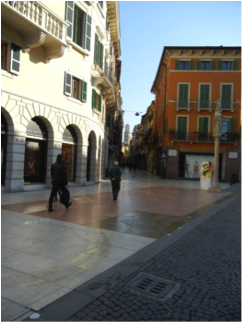
My friend Jim reminded me of a quote from Shakespeare, “There is no life beyond Verona’s walls…where Juliet lives.” And he asked me, since I was going Verona, if I could verify that statement, made so eloquently by Romeo. I can only say that life was better for the time I was there, even though that time was too short.

What a charming, enigmatic city Verona is…completely capable of making one reluctant to leave, if nothing else. I have to say that Verona is one of the most delightful cities that I have been to in Italy. Once you navigate in from the autostrada, (using the excellent directions that you printed out from your hotel), you can park the car and continue on foot from then until you leave. In the city center, everything is very close and easy to find.
  
We followed an excellent walking tour from Rick Steves and, as usual, he didn’t let us down. From the main Piazza Bra, to Juliet’s house and balcony, we never got lost, and we enjoyed our tour very much. Verona was once known as the “painted city,” for the paintings decorating the houses, and while much of that has faded, some remains. 

After we finished our tour, we got to rest for about an hour before dinner. We couldn’t decide where to go for dinner, so we consulted with Riccardo, the delightful and knowledgeable young man at the front desk at our hotel (great hotel, by the way…Hotel Torcolo).
  
He suggested we flip a coin to decide between the two restaurants in the running, so we did.  We went with the winner of the coin toss, Trattoria al Pompiere, and it was quite simply amazing. It may have been the best meal of our trip so far. It was a very friendly restaurant, with mostly Italians, which is always a good sign. At the back of the room 

where we were, there was a chef who did nothing but slice meats, organize them beautifully on a platter, and bring them personally to various  diners. There must have been at least 25 different salume to choose from, so we asked for a mixed platter for the table, making sure that one of the meats would be Proscuitto di Parma. I wish I would have taken a picture of that platter…it was beautiful. Charles picked a delicious Soave to have with the meats, and it complemented them perfectly. After that, Joan & I had Tagliatelle with Ragu (delicious), Bert had Fegato con cipolle (liver with onions…again, delicious), and Charles had a steak with roasted potatoes. We had a wonderful Valpolicella with our second course. And the best part was, we didn’t have to drive home! We did have a nice passagiata after dinner, though, and returned to our hotel, happy and full. As far as life beyond Verona’s walls…alas, there has to be, because tomorrow we must leave. Time to head to Venice!

Venice

After an early morning walk around Piazza Bra, we left Verona and headed for Venice. We decided to make two stops along the way: Vincenza, to see some structures built by Palladio and Padova, where we had decided to have lunch. Unfortunately, we had some difficulty parking in Vincenza, after having already had trouble finding the center of the city and, in frustration, we decided to skip Vincenza and just go straight to Padova for lunch. We will definitely try to get back to Vincenza, but maybe we’ll try to arrive by train next time…that might be a little easier.

We had a very nice lunch in Padova, then left for Venice. 


We arrived in Venice and, after much discussion, decided to park in Tronchetto, which is the slightly cheaper parking lot, and also one which allowed us to pick up the water taxi. In Venice, everything is done by boat, whether it’s delivering people or picking up trash (not that I’m comparing the two!). It’s really fascinating, seeing all of the services and goods delivered by all types of boats. The water taxi that we took was like a tour in itself, covering a large part of the Grand Canal before dropping us at St. Mark’s Square, which was the stop nearest to our hotel, the Hotel Diana. What a beautiful city Venice is…a true “feast for the eyes”!
  
No matter how many times I visit, Venice never fails to make me smile. We arrived about 3:30 p.m. on Tuesday, checked in, then went in search of a favorite glassmaker of Charles & Joan’s.  After successfully locating Vittorio and admiring his exquisite pieces, we decided to locate one of the many wine & cichetti bars of Venice to sample the local wines and a few appetizers. I chose a glass of Prosecco (no surprise there…I always choose Prosecco, if I have a chance). We also sampled a few interesting appetizers (potato cake, mushroom flan, artichokes, deep fried olives, deep fried meatballs, etc.). We were intending to make the chichetti our meal for the evening, but Bert wanted to sit down for his meal. 

We stumbled on a little ristorante and were reading the menu when the owner appeared and strongly suggested we come in. So we did. And we were very glad that we did! We weren’t really starving, and only wanted a little pasta, so three of us got the Spaghetti alla fruitta di mare. It was really delicious, served with lots of mussels, clams, and langoustines. Yummmm! Charles got the Fritto Misto, and that was delicious also. (Well, I think it was…he didn’t offer us any!) So that’s how it goes. Usually, you can eat well, even in a major tourist city like Venice, if you go off the beaten path a little and trust your instincts.
  
The next day we got up early and went to see some churches, especially La Salute, which is reached either by boat from St. Mark’s Square or by walking over the Accademia Bridge, which is what we did. That way, we got to wander while we were en-route to the church, never a bad thing to do in Venice. After reaching the church and admiring the inside (and taking fabulous pictures of St. Mark’s Square across the water), we found a café on the canal, where we could rest a bit and have something to drink. We decided on a bottle of Prosecco and, of course, it was delicious…or maybe the surroundings had something to with it.
  
Well, by this time, it was almost time for lunch, so we found a nice little trattoria, and enjoyed a simple, but delicious meal. I’ve heard that it’s difficult to eat well in Venice, and expensive, but I don’t agree. We were very happy with all of our meals in Venice, including the last one, which I’ll tell you about later.

After lunch, we split up, and Charles & Joan went off to do some shopping while Bert and I got lost trying to find St. Mark’s Square. We were a little frustrated and felt we were going around in circles, but eventually we found it! We took the taxi over to the see the church of San Giorgio Maggiore, designed by Palladio. There are also great views of Venice from there, and it's far from the maddening crowds around St. Mark’s Square. After taking the taxi back to St. Mark’s Square, we did a little shopping and rested up before dinner. 

So the question was, as always, “where to eat?” We thought we had a restaurant picked out, but the desk clerk at our hotel didn’t think it was O.K., plus it would have been about a 40 minute walk, which may have been difficult. So, she recommended Osteria alle Botta, near the Rialto Bridge.
  
It was really wonderful, not fancy, and just what we wanted. Bert & I both got a pasta dish (made in-house), and they were fantastic. Then Charles, Joan and Bert got a grilled fish (superb, fresh and perfectly cooked). We had a Soave to go with our meal, and that was perfect, too. I think we have new favorite restaurant in Venice!  As we strolled home from the restaurant, stopping by St. Mark’s Square once more to admire the moon over the city, we could almost imagine what it like here hundreds of years ago. One thing hasn’t changed: the magic that surrounds this city. That will be here, hopefully, for another hundred years, at least. Ciao!!

--Lynne


Saturday, March 19, 2011

Lynne and Bert in Italy: Montalcino, The Wine of Brunello, and Visiting David

MONTALCINO & PIENZA

On Monday we headed to two of our favorite hill towns, Montalcino and Pienza.  
Montalcino, of course, is famous for being the home of Brunello wines, arguably some of the best in Italy. We always visit Livio Sassetti at Pertimali Winery to get some of his delicious wine to drink while we’re here. We bought a few bottles of 2006 Brunello di Montalcino &  Rosso di Montalcino and a case of 2007 Montecucco, made with 100% Sangiovese. Wow…I have to say…that is one good “house wine,” and not a bad deal @ 9 Euros per bottle!

After our visit to the winery, we had lunch at the same restaurant in Montalcino where we always eat, Osteria di Porta Cassera. It’s a very simple restaurant, but the food is always good and dependable. We always get the house wine here, and since it’s in the middle of Brunello country, it’s delicious.
After lunch, we headed to Pienza, a beautiful hill town and very well preserved Renaissance city. (They actually filmed Zefferelli’s “Romeo & Juliet” there many years ago, not in Verona). It also just happens to be the best place to buy Pecorino cheese, a delicious cheese made from sheep’s milk. And that’s exactly what we did. Our usual shop has samples out to try, so you can decide which cheese you want to buy, and they will even vacuum pack it, so you can take it home to the U.S.A. with you…(yes, it’s legal!).

There are always at least 3 or 4 different cheeses to try, all the same, just a different age. The youngest is aged 3 months, then the next is 6 months, and the next is one year. As they get older, of course, they are more complex and harder. You just have to find the one that you like the best. I actually like all of them!
We usually eat at Latte di Luna in Pienza but, unfortunately, they were closed. So, we’ll have to go back later in our trip. I can’t miss eating there at least once while we’re in Italy. They have the most amazing Roast Suckling Pig, Fettucini with Truffles, and Gnocci with Ragu. This restaurant is definitely worth a special trip. Luckily, we have a reason to go back…we haven’t bought our cheese yet to take home to the U.S.A.!!
                                  
The next day, we were going to go to Pitigiano, the city where three of Bert’s grandparents were born, but one of our guests had a slight medical emergency, so we had to stay close to home to take care of that. We did go that night to another of our favorite restaurants La Lampara, in Porto Ercole, for pizza. 

SIENA

We headed back to the villa to rest up and get ready for a big day on Wednesday: our visit to Florence. We left early for Florence, and decided to stop in Siena on the way. It’s absolutely a city that one has to see and, in medieval times, it was the rival of Florence. Unfortunately, the Black Death in the 13th century depleted the city by one-third and they never really recovered, eventually falling under the rule of the Florentines.

But there is an amazing main square called Il Campo where twice a year they hold horse races around the perimeter. 10 out of the 17 “neighborhoods” compete in the races (chosen by rotation and lot), and the winners get bragging rights for the next year, so it’s very important to the citizens of Siena. There is also an amazing Duomo in Siena which can’t be missed, and in fact, it wasn’t missed by us. There are so many beautiful churches in Italy, but I have to say that Siena’s Duomo is one of my very favorites. It is nicknamed the “Zebra” church, because of the stripes in the interior.  After having lunch and another gelato, we headed to Florence, with another important stop along the way. Bert’s uncle was killed in Italy in WWII and is buried at the American Cemetery in Florence, so we always stop there on our way to Florence to pay our respects. It’s quite a sight to see. We are always moved, seeing all of those white crosses.                      

FLORENCE

O.K., so we arrived in Florence about 2:30 pm (or 15:30, as the time is displayed in Italy), and headed first for the Piazzale Michelangelo, which is where we always take our guests as we enter the city. It’s a huge piazza overlooking the city, where the view is spectacular, and of course, it’s a perfect place for our first photos of Florence.

After enjoying the view, we drove to our hotel, Hotel Cosimo di Medici, another new find for us, and checked in. It was great, and we would definitely recommend it.  We walked to the Duomo and went inside to admire the amazing dome. Bert & Linda decided to walk to the top of the Duomo (463 steps!!!) while Jack & I held down the fort in the Piazza below. Yes, they did it! (And they have the pictures from the top to prove it!)

We then walked back to the hotel to rest before dinner at Quattro Leone, where they have traditional Tuscan food and are very friendly. One of their specialties is Finochietti, which are little “purses” of pasta filled with Taleggio cheese and pear, served with a cream and asparagus sauce. Linda & I had that, Bert had a delicious steak, and Jack had lasagna made with artichokes. Yummm!

Tomorrow, we have a date with David!
                      
We got up and had breakfast at our hotel and headed for the Accademia to see David by Michelangelo, and on the way we walked through the San Lorenzo markets, which go on forever. O.K. not really forever, but it seems like that. They have amazing deals on everything from scarves to leather jackets. We were on our way to see David, though, so our shopping would have to wait until later. Again, I’ve seen David many times, but wanted to go with our guests, and he still blows me away. It’s hard to explain what it’s like standing next to that incredible sculpture. So, I won’t.

After we left the Accademia, we walked to Le Mossace for lunch, and then walked around after lunch, until we ran out of steam, and went to rest up for our big dinner that night. I know…it seems like we’re always eating…but the food is amazing, what can I say? That night we ate dinner at Il Latini, which is quite famous, and we always try to eat there when we’re in Florence. I’ve never seen a menu there. The waiter asks if you would like the appetizers, and then if you would like a primi (first course, such as pasta or soup), and then if you want a meat. The best thing here is the “bistecca alla fiorentina,” which is a massive steak served rare (just like Bert likes it!). I usually pass on that and go for the pasta. After dinner, our waiter, Nino, brought us a selection of desserts to share, biscotti and Vin Santo, and then the evening was topped off with Moscato, a delicious sparkling wine.  Before leaving, we were presented with a bottle of their own wine to take home. Suffice to say, it’s an experience to eat there.  
After a leisurely passeggiata back to the hotel, we turned in and got some much needed rest after a busy day. We left Florence and navigated out of the city without a hitch and headed for Pisa, which just happened to be on our way home, to see the most iconic structure in Italy.

PISA
                                   
We got there in time to have lunch (pizza), and admired the “Field of Miracles” where the leaning Tower of Pisa is located. We were understandably impressed and glad we had stopped to see it. Seeing it in photographs just doesn’t do it justice. The Duomo was also worth seeing, and I was glad that we paid the 2 Euros to go inside. I know, right? Another beautiful church! Just when you think you’re becoming jaded, you see another one! We spent some time there taking scads of photos (yes, we even took one of Linda “holding” up the tower).


Villa Colombina

We drove back to Porto Santo Stefano and arrived home in time to rest up for dinner.  Saturday morning was windy and cold, but that didn’t deter Linda & me from going to the weekly mercato in Orbetello. I will say we didn’t spend too much time there because the weather  was pretty miserable, so we left and spent the rest of the afternoon at home, cooking our own lunch and dinner.

The only thing we bought at the market were some tomatoes and some pane (bread)for lunch. Oh, I did buy a beautiful scarf…evidently, I didn’t buy enough scarves in Florence…I never do! Oh, who to give it to…or maybe that will be the one I keep for myself!  We were hoping again to go to Pitigliano, but the weather was so bad on Sunday (it was a cold, windy, rainy day), that we didn’t go out at all, until dinner.  Bert & I were disappointed, because we really wanted Linda & Jack to see Pitigliano, but I guess that will have to wait until the next visit. (Remember the coin in the fountain in Rome?)  Their last dinner was in Porto Santo Stefano at Il Foro, with all of their new Italian friends. We had grilled shrimp, fried mixed seafood, pizza, and spaghetti alla vongole, and I think they really enjoyed their last dinner in Italy. Today (Monday), we took them to the airport, and have spent a quiet day at home, anticipating our next guests, friends who will be arriving on Friday. Next week we will be traveling to Verona & Venice, and will write more about that later. 

Ciao for now!  

--Lynne
  

Wednesday, March 16, 2011

Lynne and Bert in Italy: Rome, Porto Santo Stefano, and Villa Colombina

Well, we’re 2 weeks into our trip and have had a wonderful, albeit wet, time so far. It seems like it has rained more than not, but that hasn’t deterred us. Here’s what we have been up to...

ROME
We arrived in Rome last Friday, March 4th and stayed one night after picking up my brother and his wife at the airport. We stayed at a very nice hotel near Termini (the main train station in Rome) called Hotel Serena. It was the first time we had stayed at this particular hotel, and we would definitely stay there again. After having lunch at a small trattoria near the hotel, we walked to the Forum and Colosseum,  and then afterwards headed for the Trevi  Fountain. 

You can’t visit Rome without visiting the Trevi Fountain.


My brother and his wife threw the ubiquitous coins in so they could assure their return someday. Then, that accomplished, we headed back to the hotel, after getting lost a few times, to rest before dinner. We had a very nice dinner, then walked a little bit afterwards while enjoying the first gelato of our trip. (The first of many, trust me!). Bert got his usual: half coconut, half chocolate. He’s definitely in a rut (but it’s a good one!), while I hardly ever get the same flavor twice. Jack & Linda also had their first gelato ever…yes, they’re hooked, too!  Linda vowed that the next gelato would be in a cone, not a cup. It’s the same price for either, and you can always combine two flavors. With so many flavors to try, that’s the smart thing to do.


The next morning, we were up early and grabbed a taxi to go to St Peter’s Basilica. We were there early enough to beat the crowd and were rewarded with shorter lines than usual. No matter how many times we see that church (and we’ve seen it many times), it never fails to impress us. Jack & Linda were blown away by the magnitude of the church and the beautiful mosaics inside. Of course, the crown jewel, the Pieta by Michaelangelo, was breathtaking, as always. 


PORTO SANTO STEFANO & VILLA COLOMBINA

So, back to the hotel to pick up our bags, we grabbed a sandwich to eat on the train to the airport, jumped on the train, picked up our car, and headed home. We arrived at Villa Colombina about 3:00 pm, unpacked, and settled in. Of course, Jack & Linda were anxious to see the house and grounds, so we gave them the grand tour before heading out to dinner with our Italian friends at our favorite restaurant, Il Foro, in Porto Santo Stefano.

We had ordered a specialty of the house ahead of time, Zuppa di Pesce, and it was amazing. First, they brought a large bowl filled with a delicious broth, and bowls of crusty bread. Those of us having the Zuppa were given a bowl and a knife and fork. So, there I am, waiting for my spoon, and when it didn’t materialize, I asked the waitress for it. Well, everyone looked at me and Luciana said, “Oh, no, you don’t use a spoon! You just pour the broth over the bread, and it soaks up the broth, and you eat it with a fork.” (Of course, she said this in Italian, and I didn’t understand it completely. Thank goodness for hand gestures and that Italians can’t talk without them!)

Then the waitress arrived with the piece de resistance, a huge platter filled with the seafood that had been used to make the broth. I wish I had taken a picture of that platter, but, alas, I didn’t. It was delicious!! Jack had Spaghetti alla Vongole (spaghetti with clams) and was suitably impressed. Bert always gets that when he can.  It’s made with these amazing tiny little clams and is absolutely delicious.  Jack & Linda couldn’t understand much of the conversation, as it was all in Italian, but they have made a lot of new friends nonetheless.

--Lynne


Wednesday, March 2, 2011

Is Direct-to-Consumer Shipping in Maryland's Future?

Imagine my surprise (having been born and raised in Maryland) when I walked into the Whole Foods around the corner from my sister’s place in Alexandria, Virginia one hazy summer afternoon three years ago to find that there were two entire aisles devoted to beer and wine. In the grocery store?! I was, to say the least, floored and slightly scandalized. It had never once in my then eighteen years occurred to me that where, when and how consumers can purchase alcohol is not a federal mandate, but up to state legislators.

Having said this, I feel compelled to admit that it never particularly bothered me when I was growing up that we would have to stop at a special store, and I certainly never imagined having alcohol shipped directly to our door. Perhaps this is because I was not yet 21, but it’s entirely more likely that I simply couldn’t miss what I’d never experienced.

Either way, I never thought much about the where and the when and the how of purchasing alcohol until I began working at Basignani in January.

Which brings me to the real subject of this post: HB 234 and SB 248.

Currently on the legislative table, these bills propose (on the recommendation of the Comptroller’s report) that Maryland legalize direct-to-consumer shipping for both in- and out-of-state manufacturers of alcoholic beverages.

Only 13 states in the union do not allow direct shipment of wine to consumers. Some of the reasons “why not” include accessibility to minors and potential tax evasion. The bill addresses many potential issues, including placing stringent regulations on both the manufacturer and the controlled carrier (i.e. UPS, FedEx, etc.) that require verification of the consumer’s age both at the time of purchase and upon receipt of the package.  

To understand the other concerns connected with the bill, it is first necessary to understand how alcohol distribution currently works in Maryland.

We have a three-tier system:


In words, manufacturers sell to wholesalers who distribute to the retailers where you and I can purchase our preferred labels. The new bill would allow manufacturers and consumers to bypass wholesalers and retailers for direct-to-consumer purchases. This would, according to the Comptroller’s report, benefit consumers motivated more by brand than by price. Which makes sense, if you stop to think about it. Look at it this way:

The average consumer is not going to go online, purchase wine or beer, pay shipping, and then wait the three to five days for the package to arrive. It’s simply much more expedient (and cost-effective!) to run to the corner store. But for those consumers who enjoy a particular winery or wish to purchase a collector’s bottle in an auction, well—this is their chance.

According to the Comptroller’s report, “the three-tier regulatory framework was implemented [following the end of Prohibition] to achieve the goals of temperance, orderly sale of alcoholic beverages, and respect and obedience to law” (40).

Whether or not this new bill is in violation of this intent, well that is up for our elected officials to decide.

The bill will be heard by legislative committees in both the House and the Senate on Friday, so contact your local legislator and have your say!

For more information, see the Comptroller’s Report or the Maryland Wineries’ Association website. 

Monday, February 21, 2011

The Taste of a Place

Once again I have found something in my daily life much more interesting than the age-old debate between red and white (so, if you really want to know the difference, you may just have to find me and contrive to make a scene about choosing one over the other; if I have some good anecdotal material, maybe I’ll finally get around to writing that post…).

But in the meantime:

Terroir. A word loaned from the French loosely meaning “sense of place,” terroir is what gives wines from different countries and regions their character. You can (ostensibly) plant the same grapes in South America, New Zealand, France and the United States, but despite their related DNA, none of the wines will taste the same.

Wait? What?! Grapes are grapes and they make wine, right? Wrong.

Grapes may be grapes, but not all parcels of land (and, therefore, not all bottles of wine) are created equal.  

How is this even remotely more interesting than the ongoing turf war between Reds and Whites? Well, perhaps it’s not. But I was sitting in class the other day discussing, of all things, an essay on cheese when the professor mentioned terroir with a pointed look in my direction (as my internship coordinator, he is well-aware that I am currently working at Basignani).

Much to my chagrin, last Thursday and that pointed look revealed yet another term I should know.

Besides being one of the more pronounceable French words associated with wine and winemaking, terroir connotes the special characteristics that soil, climate, geography, and even the choices the vintner makes during the growing season give a particular wine. I think I like how Washington Post staff writer, Jane Porter said it best: terroir is “a French term that literally translates as terrain but has come to mean the way foods and wine express the soil, climate, culture and tradition of a region.” (I am especially fond of that last bit, wines as expressing culture and tradition—when you open a good bottle of wine, can’t you just taste its history?)

Though the concept of terroir has been around since the ancient world, the French really deserve the credit for cementing our modern understanding of the term as how place influences taste (Napoleon III created the first protected region, Bordeaux’s Grand Crus area, in 1855). Perhaps the most famous terroir dispute is over the use of “Champagne” in sparkling wine labels. Vineyards from the Champagne region in France claim that their climate and location give the sparkling wine a certain finesse that cannot be achieved anywhere else. They would, as a result, appreciate it if other winemakers (particularly non-European winemakers, since the E.U. defines and protects specific growing areas) refrained from labeling their sparkling wines Champagne because, well, they aren’t Champagne.

What could any of this possibly have to do with Basignani? Well, quite a bit, actually.

For example, we grow Chardonnay here at the main vineyard and over on Belfast Road, but the resulting wines have radically different flavor profiles. Now, Bert hesitates to lay this entirely at the feet of terroir, as the vineyards are old and were planted before people paid much attention to clones (making it impossible to determine just how related these vines are). But he did give me an interesting metaphor that stated more clearly than any of the definitions I found online, precisely what terroir is:

“Vines are like people in that if you move them from where they were originally and they settle into a new spot, well, eventually they change.”

Vines, then—like people—settle; they take on the flavor of the area. Where a Yankee transplanted in the South might eventually develop a bit of a drawl to his or her normally clipped speech, a vine may just pick up a note of that honeysuckle flowering at the edge of the forest.

I wonder if perhaps Maryland wines, like Marylanders, display a particular blend of North and South?...but that is, alas, a topic for another blog. 

Monday, February 14, 2011

To Filter or Not to Filter?


I know, I know. If you read my last post, I promised to go over the difference between red and white in this, my next blog. But I hope you’ll forgive my digression to a more apropos discussion of filtered versus unfiltered wines. (Alright, it’s really only more pertinent than delineating what makes a red a red and a white a white--besides their color--because it came up over the weekend when my friends and I split a bottle of Basignani’s Marisa. But as they say: timing is everything….)

The motivation for my digression began a little like this:

“Oh good, it’s unfiltered!”

What is he talking about? I made a noncommittal noise as my friend finished reading the label and passed me the bottle to uncork. While I used my winged, you’d-have-to-be-an-idiot-to-mess-this-up corkscrew (sorry to my roommate if she reads this, but I still don’t understand how she managed to push a cork into the bottle a couple of weeks ago), I vowed to look up the difference between unfiltered and filtered wine at the earliest possible opportunity. After all, of the three of us, I’m the one working at a winery. This, I thought, is something I should know.

That was Friday. My determination to understand this filtered versus unfiltered business was cemented the next evening (Saturday, for those of you without easy access to a calendar) when one of my friends finished the bottle and discovered sediment in the bottom of her glass:

“Umm, Ryn. What’s that?” She tapped a curious and slightly cautious finger against her glass, directing my attention to the small pool of red at the bottom.

“Sediment. It’s unfiltered.” I could tell she was impressed with my ability to put two and two together and get four (a special thanks to my other friend who’d noticed the UNFILTERED printed on the label, therefore enabling me to sound knowledgeable), but her question made me realize that observing a correlation between the word “unfiltered” and the presence of sediment in the bottle was really just the beginning.

Again, I thought, This is something I should know.

My first instinct, as a member of Generation-Y (or whatever you want to call us), was to Google. So I did. Though there are a lot of hits for “Filtered versus Unfiltered Wine,” none of them seemed particularly reliable (with the notable exception of eHow.com).

So, I harkened back to elementary school and the days before Internet research. Yes, that’s right, I opened a book! I got out my copy of Phillip Wagner’s Grapes into Wine and used the index (the INDEX!) to look up filtration. Though his discussion is perhaps a bit too in-depth for a blog post, I thought I’d give you the highlights of wine clarification: what it is and whether or not it matters to the average consumer.

Sediment in wine is natural, even unavoidable—small particles from the grapes and dead yeast cells are inevitably left behind. Sediment, to me, has a bit of a negative connotation (after all, we talk disparagingly about sediment making rivers and streams murky) so I feel compelled to point out that there is nothing inherently good or bad about sediment in wine. It just is. The particles found in wine include tannins, coloring phenols and proteins—all of which are natural and none of which are harmful if consumed.

Still, some consumers (especially within the past 50 years) have come to equate clarity with quality. To clarify wine, some winemakers use finings (an agent that bonds with the suspended particles in the wine, pulling them to the bottom) while others use filtration.

Filtration, according to Wagner, “is in a sense the reverse of fining. When a wine is fined a sort of veil of the fining material is drawn down through the wine, dragging all suspended matter with it. When a wine is filtered the veil, a porous wall or membrane, is fixed and the wine is forced through it, leaving the suspended material behind and emerging clear and bright” (189).

There are several advantages to filtration over fining, including: time (filtration is much quicker than fining), consistency, the lack of chemical reactions, and the simple fact that filtration can be implemented at any point in the winemaking process (190). Despite these advantages, however, some winemakers are reluctant to filter, as the process may change the quality of the wine’s flavor and aroma, not to mention its aging potential.

Here at Basignani, we prefer to leave our dry wines unfiltered. If you’re worried about sediment (as drinking the sediment itself doesn’t taste very good) you can decant the wine, then pour carefully to keep the sediment out of the wine glasses. (In other words, don’t pour like a college student and upend the bottle…wine is not always good to the last drop!) 


Wagner, Philip M. Grapes into Wine: A Guide to Winemaking in America. New York, NY: Knopf, 1986. Print.