Monday, March 28, 2011

Lynne and Bert in Italy: Verona and Venice


I promised an update to our travels, so here we go! After our friends Joan & Charles arrived last Friday, we had a pretty quiet weekend. Yes, we went to the mercato again on Saturday; no, I didn’t buy any more scarves.  (I’m waiting until we go to Venice for that!) We did take Charles and Joan to Il Foro, and we had another wonderful meal there. Thank goodness I called ahead, though…they were packed! We had Spaghetti alla Vongole (again, I know…but it’s so good!) On Sunday, we cooked lunch for Bert’s cousin, Roberto, visiting from Rome. Bert made Risotto alle Gamberoni (shrimp) for our first course. After that we had roasted potatoes (have I told you yet, how good the potatoes are in Italy? ...we can’t figure out why…they just are), grilled sausages, and artichokes prepared by Charles with his special sauce. For dessert, we bought a delicious Torta della Nonna from the bakery in Porto Santa Stefano.  It was a wonderful lunch and visit, and afterwards we took our passagiata into town and back—we needed to walk off that lunch!

That was it for us. No-one wanted to eat anything else for the rest of the evening. We had to rest up and get ready for our trip to Verona the next day, anyway! (By the way, Charles & Joan brought beautiful weather with them, so hopefully no more rain until we leave!)

Verona
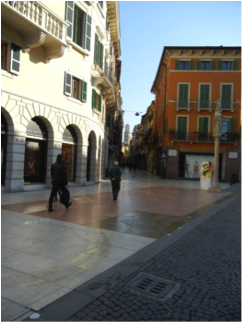
My friend Jim reminded me of a quote from Shakespeare, “There is no life beyond Verona’s walls…where Juliet lives.” And he asked me, since I was going Verona, if I could verify that statement, made so eloquently by Romeo. I can only say that life was better for the time I was there, even though that time was too short.

What a charming, enigmatic city Verona is…completely capable of making one reluctant to leave, if nothing else. I have to say that Verona is one of the most delightful cities that I have been to in Italy. Once you navigate in from the autostrada, (using the excellent directions that you printed out from your hotel), you can park the car and continue on foot from then until you leave. In the city center, everything is very close and easy to find.
  
We followed an excellent walking tour from Rick Steves and, as usual, he didn’t let us down. From the main Piazza Bra, to Juliet’s house and balcony, we never got lost, and we enjoyed our tour very much. Verona was once known as the “painted city,” for the paintings decorating the houses, and while much of that has faded, some remains. 

After we finished our tour, we got to rest for about an hour before dinner. We couldn’t decide where to go for dinner, so we consulted with Riccardo, the delightful and knowledgeable young man at the front desk at our hotel (great hotel, by the way…Hotel Torcolo).
  
He suggested we flip a coin to decide between the two restaurants in the running, so we did.  We went with the winner of the coin toss, Trattoria al Pompiere, and it was quite simply amazing. It may have been the best meal of our trip so far. It was a very friendly restaurant, with mostly Italians, which is always a good sign. At the back of the room 

where we were, there was a chef who did nothing but slice meats, organize them beautifully on a platter, and bring them personally to various  diners. There must have been at least 25 different salume to choose from, so we asked for a mixed platter for the table, making sure that one of the meats would be Proscuitto di Parma. I wish I would have taken a picture of that platter…it was beautiful. Charles picked a delicious Soave to have with the meats, and it complemented them perfectly. After that, Joan & I had Tagliatelle with Ragu (delicious), Bert had Fegato con cipolle (liver with onions…again, delicious), and Charles had a steak with roasted potatoes. We had a wonderful Valpolicella with our second course. And the best part was, we didn’t have to drive home! We did have a nice passagiata after dinner, though, and returned to our hotel, happy and full. As far as life beyond Verona’s walls…alas, there has to be, because tomorrow we must leave. Time to head to Venice!

Venice

After an early morning walk around Piazza Bra, we left Verona and headed for Venice. We decided to make two stops along the way: Vincenza, to see some structures built by Palladio and Padova, where we had decided to have lunch. Unfortunately, we had some difficulty parking in Vincenza, after having already had trouble finding the center of the city and, in frustration, we decided to skip Vincenza and just go straight to Padova for lunch. We will definitely try to get back to Vincenza, but maybe we’ll try to arrive by train next time…that might be a little easier.

We had a very nice lunch in Padova, then left for Venice. 


We arrived in Venice and, after much discussion, decided to park in Tronchetto, which is the slightly cheaper parking lot, and also one which allowed us to pick up the water taxi. In Venice, everything is done by boat, whether it’s delivering people or picking up trash (not that I’m comparing the two!). It’s really fascinating, seeing all of the services and goods delivered by all types of boats. The water taxi that we took was like a tour in itself, covering a large part of the Grand Canal before dropping us at St. Mark’s Square, which was the stop nearest to our hotel, the Hotel Diana. What a beautiful city Venice is…a true “feast for the eyes”!
  
No matter how many times I visit, Venice never fails to make me smile. We arrived about 3:30 p.m. on Tuesday, checked in, then went in search of a favorite glassmaker of Charles & Joan’s.  After successfully locating Vittorio and admiring his exquisite pieces, we decided to locate one of the many wine & cichetti bars of Venice to sample the local wines and a few appetizers. I chose a glass of Prosecco (no surprise there…I always choose Prosecco, if I have a chance). We also sampled a few interesting appetizers (potato cake, mushroom flan, artichokes, deep fried olives, deep fried meatballs, etc.). We were intending to make the chichetti our meal for the evening, but Bert wanted to sit down for his meal. 

We stumbled on a little ristorante and were reading the menu when the owner appeared and strongly suggested we come in. So we did. And we were very glad that we did! We weren’t really starving, and only wanted a little pasta, so three of us got the Spaghetti alla fruitta di mare. It was really delicious, served with lots of mussels, clams, and langoustines. Yummmm! Charles got the Fritto Misto, and that was delicious also. (Well, I think it was…he didn’t offer us any!) So that’s how it goes. Usually, you can eat well, even in a major tourist city like Venice, if you go off the beaten path a little and trust your instincts.
  
The next day we got up early and went to see some churches, especially La Salute, which is reached either by boat from St. Mark’s Square or by walking over the Accademia Bridge, which is what we did. That way, we got to wander while we were en-route to the church, never a bad thing to do in Venice. After reaching the church and admiring the inside (and taking fabulous pictures of St. Mark’s Square across the water), we found a cafĂ© on the canal, where we could rest a bit and have something to drink. We decided on a bottle of Prosecco and, of course, it was delicious…or maybe the surroundings had something to with it.
  
Well, by this time, it was almost time for lunch, so we found a nice little trattoria, and enjoyed a simple, but delicious meal. I’ve heard that it’s difficult to eat well in Venice, and expensive, but I don’t agree. We were very happy with all of our meals in Venice, including the last one, which I’ll tell you about later.

After lunch, we split up, and Charles & Joan went off to do some shopping while Bert and I got lost trying to find St. Mark’s Square. We were a little frustrated and felt we were going around in circles, but eventually we found it! We took the taxi over to the see the church of San Giorgio Maggiore, designed by Palladio. There are also great views of Venice from there, and it's far from the maddening crowds around St. Mark’s Square. After taking the taxi back to St. Mark’s Square, we did a little shopping and rested up before dinner. 

So the question was, as always, “where to eat?” We thought we had a restaurant picked out, but the desk clerk at our hotel didn’t think it was O.K., plus it would have been about a 40 minute walk, which may have been difficult. So, she recommended Osteria alle Botta, near the Rialto Bridge.
  
It was really wonderful, not fancy, and just what we wanted. Bert & I both got a pasta dish (made in-house), and they were fantastic. Then Charles, Joan and Bert got a grilled fish (superb, fresh and perfectly cooked). We had a Soave to go with our meal, and that was perfect, too. I think we have new favorite restaurant in Venice!  As we strolled home from the restaurant, stopping by St. Mark’s Square once more to admire the moon over the city, we could almost imagine what it like here hundreds of years ago. One thing hasn’t changed: the magic that surrounds this city. That will be here, hopefully, for another hundred years, at least. Ciao!!

--Lynne


Saturday, March 19, 2011

Lynne and Bert in Italy: Montalcino, The Wine of Brunello, and Visiting David

MONTALCINO & PIENZA

On Monday we headed to two of our favorite hill towns, Montalcino and Pienza.  
Montalcino, of course, is famous for being the home of Brunello wines, arguably some of the best in Italy. We always visit Livio Sassetti at Pertimali Winery to get some of his delicious wine to drink while we’re here. We bought a few bottles of 2006 Brunello di Montalcino &  Rosso di Montalcino and a case of 2007 Montecucco, made with 100% Sangiovese. Wow…I have to say…that is one good “house wine,” and not a bad deal @ 9 Euros per bottle!

After our visit to the winery, we had lunch at the same restaurant in Montalcino where we always eat, Osteria di Porta Cassera. It’s a very simple restaurant, but the food is always good and dependable. We always get the house wine here, and since it’s in the middle of Brunello country, it’s delicious.
After lunch, we headed to Pienza, a beautiful hill town and very well preserved Renaissance city. (They actually filmed Zefferelli’s “Romeo & Juliet” there many years ago, not in Verona). It also just happens to be the best place to buy Pecorino cheese, a delicious cheese made from sheep’s milk. And that’s exactly what we did. Our usual shop has samples out to try, so you can decide which cheese you want to buy, and they will even vacuum pack it, so you can take it home to the U.S.A. with you…(yes, it’s legal!).

There are always at least 3 or 4 different cheeses to try, all the same, just a different age. The youngest is aged 3 months, then the next is 6 months, and the next is one year. As they get older, of course, they are more complex and harder. You just have to find the one that you like the best. I actually like all of them!
We usually eat at Latte di Luna in Pienza but, unfortunately, they were closed. So, we’ll have to go back later in our trip. I can’t miss eating there at least once while we’re in Italy. They have the most amazing Roast Suckling Pig, Fettucini with Truffles, and Gnocci with Ragu. This restaurant is definitely worth a special trip. Luckily, we have a reason to go back…we haven’t bought our cheese yet to take home to the U.S.A.!!
                                  
The next day, we were going to go to Pitigiano, the city where three of Bert’s grandparents were born, but one of our guests had a slight medical emergency, so we had to stay close to home to take care of that. We did go that night to another of our favorite restaurants La Lampara, in Porto Ercole, for pizza. 

SIENA

We headed back to the villa to rest up and get ready for a big day on Wednesday: our visit to Florence. We left early for Florence, and decided to stop in Siena on the way. It’s absolutely a city that one has to see and, in medieval times, it was the rival of Florence. Unfortunately, the Black Death in the 13th century depleted the city by one-third and they never really recovered, eventually falling under the rule of the Florentines.

But there is an amazing main square called Il Campo where twice a year they hold horse races around the perimeter. 10 out of the 17 “neighborhoods” compete in the races (chosen by rotation and lot), and the winners get bragging rights for the next year, so it’s very important to the citizens of Siena. There is also an amazing Duomo in Siena which can’t be missed, and in fact, it wasn’t missed by us. There are so many beautiful churches in Italy, but I have to say that Siena’s Duomo is one of my very favorites. It is nicknamed the “Zebra” church, because of the stripes in the interior.  After having lunch and another gelato, we headed to Florence, with another important stop along the way. Bert’s uncle was killed in Italy in WWII and is buried at the American Cemetery in Florence, so we always stop there on our way to Florence to pay our respects. It’s quite a sight to see. We are always moved, seeing all of those white crosses.                      

FLORENCE

O.K., so we arrived in Florence about 2:30 pm (or 15:30, as the time is displayed in Italy), and headed first for the Piazzale Michelangelo, which is where we always take our guests as we enter the city. It’s a huge piazza overlooking the city, where the view is spectacular, and of course, it’s a perfect place for our first photos of Florence.

After enjoying the view, we drove to our hotel, Hotel Cosimo di Medici, another new find for us, and checked in. It was great, and we would definitely recommend it.  We walked to the Duomo and went inside to admire the amazing dome. Bert & Linda decided to walk to the top of the Duomo (463 steps!!!) while Jack & I held down the fort in the Piazza below. Yes, they did it! (And they have the pictures from the top to prove it!)

We then walked back to the hotel to rest before dinner at Quattro Leone, where they have traditional Tuscan food and are very friendly. One of their specialties is Finochietti, which are little “purses” of pasta filled with Taleggio cheese and pear, served with a cream and asparagus sauce. Linda & I had that, Bert had a delicious steak, and Jack had lasagna made with artichokes. Yummm!

Tomorrow, we have a date with David!
                      
We got up and had breakfast at our hotel and headed for the Accademia to see David by Michelangelo, and on the way we walked through the San Lorenzo markets, which go on forever. O.K. not really forever, but it seems like that. They have amazing deals on everything from scarves to leather jackets. We were on our way to see David, though, so our shopping would have to wait until later. Again, I’ve seen David many times, but wanted to go with our guests, and he still blows me away. It’s hard to explain what it’s like standing next to that incredible sculpture. So, I won’t.

After we left the Accademia, we walked to Le Mossace for lunch, and then walked around after lunch, until we ran out of steam, and went to rest up for our big dinner that night. I know…it seems like we’re always eating…but the food is amazing, what can I say? That night we ate dinner at Il Latini, which is quite famous, and we always try to eat there when we’re in Florence. I’ve never seen a menu there. The waiter asks if you would like the appetizers, and then if you would like a primi (first course, such as pasta or soup), and then if you want a meat. The best thing here is the “bistecca alla fiorentina,” which is a massive steak served rare (just like Bert likes it!). I usually pass on that and go for the pasta. After dinner, our waiter, Nino, brought us a selection of desserts to share, biscotti and Vin Santo, and then the evening was topped off with Moscato, a delicious sparkling wine.  Before leaving, we were presented with a bottle of their own wine to take home. Suffice to say, it’s an experience to eat there.  
After a leisurely passeggiata back to the hotel, we turned in and got some much needed rest after a busy day. We left Florence and navigated out of the city without a hitch and headed for Pisa, which just happened to be on our way home, to see the most iconic structure in Italy.

PISA
                                   
We got there in time to have lunch (pizza), and admired the “Field of Miracles” where the leaning Tower of Pisa is located. We were understandably impressed and glad we had stopped to see it. Seeing it in photographs just doesn’t do it justice. The Duomo was also worth seeing, and I was glad that we paid the 2 Euros to go inside. I know, right? Another beautiful church! Just when you think you’re becoming jaded, you see another one! We spent some time there taking scads of photos (yes, we even took one of Linda “holding” up the tower).


Villa Colombina

We drove back to Porto Santo Stefano and arrived home in time to rest up for dinner.  Saturday morning was windy and cold, but that didn’t deter Linda & me from going to the weekly mercato in Orbetello. I will say we didn’t spend too much time there because the weather  was pretty miserable, so we left and spent the rest of the afternoon at home, cooking our own lunch and dinner.

The only thing we bought at the market were some tomatoes and some pane (bread)for lunch. Oh, I did buy a beautiful scarf…evidently, I didn’t buy enough scarves in Florence…I never do! Oh, who to give it to…or maybe that will be the one I keep for myself!  We were hoping again to go to Pitigliano, but the weather was so bad on Sunday (it was a cold, windy, rainy day), that we didn’t go out at all, until dinner.  Bert & I were disappointed, because we really wanted Linda & Jack to see Pitigliano, but I guess that will have to wait until the next visit. (Remember the coin in the fountain in Rome?)  Their last dinner was in Porto Santo Stefano at Il Foro, with all of their new Italian friends. We had grilled shrimp, fried mixed seafood, pizza, and spaghetti alla vongole, and I think they really enjoyed their last dinner in Italy. Today (Monday), we took them to the airport, and have spent a quiet day at home, anticipating our next guests, friends who will be arriving on Friday. Next week we will be traveling to Verona & Venice, and will write more about that later. 

Ciao for now!  

--Lynne
  

Wednesday, March 16, 2011

Lynne and Bert in Italy: Rome, Porto Santo Stefano, and Villa Colombina

Well, we’re 2 weeks into our trip and have had a wonderful, albeit wet, time so far. It seems like it has rained more than not, but that hasn’t deterred us. Here’s what we have been up to...

ROME
We arrived in Rome last Friday, March 4th and stayed one night after picking up my brother and his wife at the airport. We stayed at a very nice hotel near Termini (the main train station in Rome) called Hotel Serena. It was the first time we had stayed at this particular hotel, and we would definitely stay there again. After having lunch at a small trattoria near the hotel, we walked to the Forum and Colosseum,  and then afterwards headed for the Trevi  Fountain. 

You can’t visit Rome without visiting the Trevi Fountain.


My brother and his wife threw the ubiquitous coins in so they could assure their return someday. Then, that accomplished, we headed back to the hotel, after getting lost a few times, to rest before dinner. We had a very nice dinner, then walked a little bit afterwards while enjoying the first gelato of our trip. (The first of many, trust me!). Bert got his usual: half coconut, half chocolate. He’s definitely in a rut (but it’s a good one!), while I hardly ever get the same flavor twice. Jack & Linda also had their first gelato ever…yes, they’re hooked, too!  Linda vowed that the next gelato would be in a cone, not a cup. It’s the same price for either, and you can always combine two flavors. With so many flavors to try, that’s the smart thing to do.


The next morning, we were up early and grabbed a taxi to go to St Peter’s Basilica. We were there early enough to beat the crowd and were rewarded with shorter lines than usual. No matter how many times we see that church (and we’ve seen it many times), it never fails to impress us. Jack & Linda were blown away by the magnitude of the church and the beautiful mosaics inside. Of course, the crown jewel, the Pieta by Michaelangelo, was breathtaking, as always. 


PORTO SANTO STEFANO & VILLA COLOMBINA

So, back to the hotel to pick up our bags, we grabbed a sandwich to eat on the train to the airport, jumped on the train, picked up our car, and headed home. We arrived at Villa Colombina about 3:00 pm, unpacked, and settled in. Of course, Jack & Linda were anxious to see the house and grounds, so we gave them the grand tour before heading out to dinner with our Italian friends at our favorite restaurant, Il Foro, in Porto Santo Stefano.

We had ordered a specialty of the house ahead of time, Zuppa di Pesce, and it was amazing. First, they brought a large bowl filled with a delicious broth, and bowls of crusty bread. Those of us having the Zuppa were given a bowl and a knife and fork. So, there I am, waiting for my spoon, and when it didn’t materialize, I asked the waitress for it. Well, everyone looked at me and Luciana said, “Oh, no, you don’t use a spoon! You just pour the broth over the bread, and it soaks up the broth, and you eat it with a fork.” (Of course, she said this in Italian, and I didn’t understand it completely. Thank goodness for hand gestures and that Italians can’t talk without them!)

Then the waitress arrived with the piece de resistance, a huge platter filled with the seafood that had been used to make the broth. I wish I had taken a picture of that platter, but, alas, I didn’t. It was delicious!! Jack had Spaghetti alla Vongole (spaghetti with clams) and was suitably impressed. Bert always gets that when he can.  It’s made with these amazing tiny little clams and is absolutely delicious.  Jack & Linda couldn’t understand much of the conversation, as it was all in Italian, but they have made a lot of new friends nonetheless.

--Lynne


Wednesday, March 2, 2011

Is Direct-to-Consumer Shipping in Maryland's Future?

Imagine my surprise (having been born and raised in Maryland) when I walked into the Whole Foods around the corner from my sister’s place in Alexandria, Virginia one hazy summer afternoon three years ago to find that there were two entire aisles devoted to beer and wine. In the grocery store?! I was, to say the least, floored and slightly scandalized. It had never once in my then eighteen years occurred to me that where, when and how consumers can purchase alcohol is not a federal mandate, but up to state legislators.

Having said this, I feel compelled to admit that it never particularly bothered me when I was growing up that we would have to stop at a special store, and I certainly never imagined having alcohol shipped directly to our door. Perhaps this is because I was not yet 21, but it’s entirely more likely that I simply couldn’t miss what I’d never experienced.

Either way, I never thought much about the where and the when and the how of purchasing alcohol until I began working at Basignani in January.

Which brings me to the real subject of this post: HB 234 and SB 248.

Currently on the legislative table, these bills propose (on the recommendation of the Comptroller’s report) that Maryland legalize direct-to-consumer shipping for both in- and out-of-state manufacturers of alcoholic beverages.

Only 13 states in the union do not allow direct shipment of wine to consumers. Some of the reasons “why not” include accessibility to minors and potential tax evasion. The bill addresses many potential issues, including placing stringent regulations on both the manufacturer and the controlled carrier (i.e. UPS, FedEx, etc.) that require verification of the consumer’s age both at the time of purchase and upon receipt of the package.  

To understand the other concerns connected with the bill, it is first necessary to understand how alcohol distribution currently works in Maryland.

We have a three-tier system:


In words, manufacturers sell to wholesalers who distribute to the retailers where you and I can purchase our preferred labels. The new bill would allow manufacturers and consumers to bypass wholesalers and retailers for direct-to-consumer purchases. This would, according to the Comptroller’s report, benefit consumers motivated more by brand than by price. Which makes sense, if you stop to think about it. Look at it this way:

The average consumer is not going to go online, purchase wine or beer, pay shipping, and then wait the three to five days for the package to arrive. It’s simply much more expedient (and cost-effective!) to run to the corner store. But for those consumers who enjoy a particular winery or wish to purchase a collector’s bottle in an auction, well—this is their chance.

According to the Comptroller’s report, “the three-tier regulatory framework was implemented [following the end of Prohibition] to achieve the goals of temperance, orderly sale of alcoholic beverages, and respect and obedience to law” (40).

Whether or not this new bill is in violation of this intent, well that is up for our elected officials to decide.

The bill will be heard by legislative committees in both the House and the Senate on Friday, so contact your local legislator and have your say!

For more information, see the Comptroller’s Report or the Maryland Wineries’ Association website. 

Monday, February 21, 2011

The Taste of a Place

Once again I have found something in my daily life much more interesting than the age-old debate between red and white (so, if you really want to know the difference, you may just have to find me and contrive to make a scene about choosing one over the other; if I have some good anecdotal material, maybe I’ll finally get around to writing that post…).

But in the meantime:

Terroir. A word loaned from the French loosely meaning “sense of place,” terroir is what gives wines from different countries and regions their character. You can (ostensibly) plant the same grapes in South America, New Zealand, France and the United States, but despite their related DNA, none of the wines will taste the same.

Wait? What?! Grapes are grapes and they make wine, right? Wrong.

Grapes may be grapes, but not all parcels of land (and, therefore, not all bottles of wine) are created equal.  

How is this even remotely more interesting than the ongoing turf war between Reds and Whites? Well, perhaps it’s not. But I was sitting in class the other day discussing, of all things, an essay on cheese when the professor mentioned terroir with a pointed look in my direction (as my internship coordinator, he is well-aware that I am currently working at Basignani).

Much to my chagrin, last Thursday and that pointed look revealed yet another term I should know.

Besides being one of the more pronounceable French words associated with wine and winemaking, terroir connotes the special characteristics that soil, climate, geography, and even the choices the vintner makes during the growing season give a particular wine. I think I like how Washington Post staff writer, Jane Porter said it best: terroir is “a French term that literally translates as terrain but has come to mean the way foods and wine express the soil, climate, culture and tradition of a region.” (I am especially fond of that last bit, wines as expressing culture and tradition—when you open a good bottle of wine, can’t you just taste its history?)

Though the concept of terroir has been around since the ancient world, the French really deserve the credit for cementing our modern understanding of the term as how place influences taste (Napoleon III created the first protected region, Bordeaux’s Grand Crus area, in 1855). Perhaps the most famous terroir dispute is over the use of “Champagne” in sparkling wine labels. Vineyards from the Champagne region in France claim that their climate and location give the sparkling wine a certain finesse that cannot be achieved anywhere else. They would, as a result, appreciate it if other winemakers (particularly non-European winemakers, since the E.U. defines and protects specific growing areas) refrained from labeling their sparkling wines Champagne because, well, they aren’t Champagne.

What could any of this possibly have to do with Basignani? Well, quite a bit, actually.

For example, we grow Chardonnay here at the main vineyard and over on Belfast Road, but the resulting wines have radically different flavor profiles. Now, Bert hesitates to lay this entirely at the feet of terroir, as the vineyards are old and were planted before people paid much attention to clones (making it impossible to determine just how related these vines are). But he did give me an interesting metaphor that stated more clearly than any of the definitions I found online, precisely what terroir is:

“Vines are like people in that if you move them from where they were originally and they settle into a new spot, well, eventually they change.”

Vines, then—like people—settle; they take on the flavor of the area. Where a Yankee transplanted in the South might eventually develop a bit of a drawl to his or her normally clipped speech, a vine may just pick up a note of that honeysuckle flowering at the edge of the forest.

I wonder if perhaps Maryland wines, like Marylanders, display a particular blend of North and South?...but that is, alas, a topic for another blog. 

Monday, February 14, 2011

To Filter or Not to Filter?


I know, I know. If you read my last post, I promised to go over the difference between red and white in this, my next blog. But I hope you’ll forgive my digression to a more apropos discussion of filtered versus unfiltered wines. (Alright, it’s really only more pertinent than delineating what makes a red a red and a white a white--besides their color--because it came up over the weekend when my friends and I split a bottle of Basignani’s Marisa. But as they say: timing is everything….)

The motivation for my digression began a little like this:

“Oh good, it’s unfiltered!”

What is he talking about? I made a noncommittal noise as my friend finished reading the label and passed me the bottle to uncork. While I used my winged, you’d-have-to-be-an-idiot-to-mess-this-up corkscrew (sorry to my roommate if she reads this, but I still don’t understand how she managed to push a cork into the bottle a couple of weeks ago), I vowed to look up the difference between unfiltered and filtered wine at the earliest possible opportunity. After all, of the three of us, I’m the one working at a winery. This, I thought, is something I should know.

That was Friday. My determination to understand this filtered versus unfiltered business was cemented the next evening (Saturday, for those of you without easy access to a calendar) when one of my friends finished the bottle and discovered sediment in the bottom of her glass:

“Umm, Ryn. What’s that?” She tapped a curious and slightly cautious finger against her glass, directing my attention to the small pool of red at the bottom.

“Sediment. It’s unfiltered.” I could tell she was impressed with my ability to put two and two together and get four (a special thanks to my other friend who’d noticed the UNFILTERED printed on the label, therefore enabling me to sound knowledgeable), but her question made me realize that observing a correlation between the word “unfiltered” and the presence of sediment in the bottle was really just the beginning.

Again, I thought, This is something I should know.

My first instinct, as a member of Generation-Y (or whatever you want to call us), was to Google. So I did. Though there are a lot of hits for “Filtered versus Unfiltered Wine,” none of them seemed particularly reliable (with the notable exception of eHow.com).

So, I harkened back to elementary school and the days before Internet research. Yes, that’s right, I opened a book! I got out my copy of Phillip Wagner’s Grapes into Wine and used the index (the INDEX!) to look up filtration. Though his discussion is perhaps a bit too in-depth for a blog post, I thought I’d give you the highlights of wine clarification: what it is and whether or not it matters to the average consumer.

Sediment in wine is natural, even unavoidable—small particles from the grapes and dead yeast cells are inevitably left behind. Sediment, to me, has a bit of a negative connotation (after all, we talk disparagingly about sediment making rivers and streams murky) so I feel compelled to point out that there is nothing inherently good or bad about sediment in wine. It just is. The particles found in wine include tannins, coloring phenols and proteins—all of which are natural and none of which are harmful if consumed.

Still, some consumers (especially within the past 50 years) have come to equate clarity with quality. To clarify wine, some winemakers use finings (an agent that bonds with the suspended particles in the wine, pulling them to the bottom) while others use filtration.

Filtration, according to Wagner, “is in a sense the reverse of fining. When a wine is fined a sort of veil of the fining material is drawn down through the wine, dragging all suspended matter with it. When a wine is filtered the veil, a porous wall or membrane, is fixed and the wine is forced through it, leaving the suspended material behind and emerging clear and bright” (189).

There are several advantages to filtration over fining, including: time (filtration is much quicker than fining), consistency, the lack of chemical reactions, and the simple fact that filtration can be implemented at any point in the winemaking process (190). Despite these advantages, however, some winemakers are reluctant to filter, as the process may change the quality of the wine’s flavor and aroma, not to mention its aging potential.

Here at Basignani, we prefer to leave our dry wines unfiltered. If you’re worried about sediment (as drinking the sediment itself doesn’t taste very good) you can decant the wine, then pour carefully to keep the sediment out of the wine glasses. (In other words, don’t pour like a college student and upend the bottle…wine is not always good to the last drop!) 


Wagner, Philip M. Grapes into Wine: A Guide to Winemaking in America. New York, NY: Knopf, 1986. Print.

Monday, February 7, 2011

A True Family Affair


Family-owned and operated. It’s a marketing catch phrase we hear often enough, tossed around as it is with such seeming abandon by advertising agencies for everything from mom-and-pop shops to S.C. Johnson. (I bet at least 68% of you subconsciously filled in “a family company” after reading S.C. Johnson, didn’t you? Yes, it’s that pervasive. But I digress, and that’s a subject for another blog post.)

When we say that Basignani is a family vineyard, we truly mean it.

In fact, I’m one of very few interlopers on the premises. My first day in the small, pleasantly cluttered office above the tasting room, I met not only Bert and Lynne, but also their daughter Marisa and later her husband Griffin. My next day in the office, I met Elena and Ben, Lynne and Bert’s other daughter and son-in-law. Actually, the only adult members of the family I’ve yet to meet are Erik and Lawrence. I’m sure it’s only a matter of time.

And it’s not what you’re thinking—Marisa and Griffin and Elena and Ben didn’t just stop by to check out the new foster kid. Each of them is intimately involved with some aspect of running the winery, whether in the fields or handling the business side of the operation. Meeting me was just a bonus (or, at least, I’d like to think so!).

There are a few other family members at Basignani that definitely deserve mention, even if they are of the four-legged variety. Most afternoons the Basignani Border Collies can be found outside the tasting room, or even up in the office, laying patiently (or sometimes not so patiently) at our feet in anticipation of a couple pats on the head.

You’ve probably noticed by now that I’ve left out a few very important members of the family: the wines. But as I’m still not well versed in tasting and describing wines, I think you’ll appreciate my restraint as much as Lynne and Bert in not attempting to tackle the list just yet. I will, however, share with you a few general wine facts that I’ve discovered over the past few weeks, beginning in the next post with the difference between red and white (it’s not as clear as you might think) and why wine might be considered an…acquired taste.