Monday, May 2, 2011

Cinco de Mayo...with a twist

Cinco de Mayo may be traditionally celebrated (in the US) with margaritas and Corona, but this year my friends and I have decided to try something a little different: Sangria.

Cinco de Mayo is a Mexican holiday commemorating the Mexican army’s victory against French forces at Puebla on 5 May 1862. It is not, despite common misconceptions, Mexican Independence Day (which is actually celebrated on 16 September). Many estadounidenses (literally translated as United Stateseans) think of Cinco de Mayo as a day to celebrate Americans with Mexican heritage, much along the lines of St. Patrick’s Day or the Chinese New Year.

Though Spain and Portugal are the two countries most commonly associated with sangria, this wine-based punch is also served in many South American countries (as well as Mexican restaurants in the States).

To celebrate the end of our final spring semester (which happens to coincide nicely with Cinco de Mayo) my roommates and I are resurrecting the Taco Thursdays that went by the wayside rather quickly as our schedules got busier and busier back in September.  

Taco Thursdays entail:

**Taco Filling:
1-2 red onions, diced
6-12 peppers, sliced  (depending on the number of RSVPs)
Other vegetables (squash, eggplant, etc) as desired
1-2 cans Chickpeas, boiled
Taco Seasoning (pick your favorite kind…mine is the Simply Organic Fajita Seasoning...and follow the directions on the packet)
(Sautéed ground beef or boiled, shredded chicken can also be added)

Sautee onion in a little olive oil until lightly browned, then add peppers and other vegetables. Add taco seasoning, water, and chickpeas (drained). Simmer until thick.

**Spanish Rice (I’ll admit, I use a packet)

**Refried Beans (microwave with salsa and cheese)

**Sour Cream

**Salsa

**Cheese

**Guacamole:
4-6 ripe avocados (slightly soft, but not squishy), mashed
Fresh tomato, diced
1 red onion, diced
Cilantro, garlic, salt, pepper, and lime juice to taste

**LOTS of friends, food, wine and conversation (hopefully enough to spill onto the balcony!)

To this particular Taco Thursday, we are adding Basignani Sangria.

Traditionally, sangria is a young red wine blended with triple sec or brandy, orange juice, and fresh fruit (oranges, apples, lemons, pears, berries etc.). At Basignani Lynne makes two sangrias, a white and a red, with the Elena (a Seyval blend) and the Marisa (a blend of Foch, Chambourcin and Chancellor). I will be making both on Thursday to appease taste buds of the red and white wine drinkers. I can’t wait to find out which one tastes better with our tacos!

**Red Sangria

1 bottle Marisa
1 c. O.J.
1 c. Club Sprite
1/2 c. Sugar
1/4 c. Triple Sec and/or Brandy
Assorted sliced fruit (1 lemon, 1 lime, 1 orange)

Mix together and serve over ice.

**White Sangria

1 bottle Elena
1 c. White Grape Juice
1 c. Club Soda
1/2 c. Sugar
1/4 c. Triple Sec and/or Brandy
Assorted sliced fruit (1 lemon, 1 lime, 1 pear, 1 peach, strawberries)

Mix together and serve over ice. 

Monday, April 25, 2011

Bottling: A Lesson in Adversity

As I stood just outside the shade of the bottling truck, attempting to catch a little of Thursday’s beautiful 60-degree sun, I heard a grumbling mantra of “Murphy’s Law” coming from the direction of Joe, the bottling line technician. If it wasn’t one thing (the wet, humid weather on Tuesday) it was another (a mechanical problem with the labeler on Thursday).

Bottling was not off to an auspicious start.

There are lots of little things that can go wrong with a bottling, so I guess we should count ourselves lucky that both days the difficulties were more aesthetic than anything else. On Tuesday we couldn’t get the labels to stick to the bottles and on Thursday the sensor was malfunctioning and the labeler put too many labels (or none at all!) on the bottles.

But around midday Joe and Hunter figured out what was tripping the sensor and we were off and bottling!

My first job was to take a paper towel and wipe any drips off the bottles as the came down the line, after they were corked but before they got to the labeler. Well, being a bottling/assembly line novice, I was convinced that the bottles had to stay distanced precisely as they came out of the corker…

But then Joe came over and, much to my horrified surprise, picked one up—right off the line—and disturbed the symmetry. Then he wiped the bottle clean and let me in on a little secret: you see that sensor there (about, ohh a foot to my right and definitely within my peripheral vision)? It stops them, so they don’t have to be a specific distance apart. And indeed, the bottles were backing up in front of the sensor, waiting patiently to be capped.

Needless to say, I felt observant.

It wasn’t long until they moved me from drip-duty to catching the bottles as they came off the line, inspecting the labels and caps for imperfections and placing them in cases. Griff assured me that he usually does this job by himself, but I’m not at all sure how he manages to put the bottles in the case, send the full case down to Bert to finish packaging and put an empty case on the table in time to catch the next bottle coming down the line.

Granted, bottling our sweet wines is a bit of an unusual situation. We bottle the Vidal and Riesling in the tall bottles traditionally used in the Rhine valley in Germany (where Riesling originated). Because of their shape and height, these bottles are more prone to tipping. On Thursday, they’d come off the line normally, but instead of milling patiently, gathering to the side of the conveyor belt, one or another of the bottles would tip just slightly and we’d have sticky glass dominoes (I am happy to report that there were no casualties in the bottling of Basignani wine). Emily and I had our hands full, and I for one am glad I had help!  

I left the winery Thursday evening tired, sticky and smelling of fermented grape. And I’ll admit that my lily-white, never-done-an-honest-day’s-labor-in-my-life hands spent the weekend slathered in cream, much to my family’s amusement, but it was worth it! 

Monday, April 18, 2011

The Mystery of the Cork

Until Lynne asked me to help with the bottling, I never gave more than a cursory thought to what is surely most people’s first question about wine-making: how do they get the cork in the bottle?? (It is, after all, such a damn nuisance to get out…)

Consequently, I spent quite a bit of time thinking about this over the weekend. And I’ve reached the conclusion that getting the cork in the bottle must be rather like the question: which came first, the chicken or the egg? (Ok, maybe not really, since you couldn’t possibly fire the glass around the cork and still get the wine inside (…or could you?). 

As I said, quite a bit of time.

The most entertaining of my imaginings involved a somehow shrunken cork that magically expands to fill the hole and seal the bottle when you touch it against the inside of the bottle neck with a pair of sterilized tongues (yes, Health and Safety regulations were even featured in my oh-so-thorough daydreams). In my imagination, corking was rather like...building a ship-in-a-bottle that displays full sail after you pull the string (assuming you’ve assembled the pieces correctly).

But while amusing, and with a distracting element of mystery (how does that cork know just when to expand?), this theory doesn’t make much—all right, not any—sense at all. First of all, the bottle in my theory was lying on its side. Given that it was supposedly full of wine at the time, well, it was quite the reality-defying cogitation as not a single drop of the ruby liquid was sacrificed. (It is also interesting that the wine in question was red, since we will be bottling the Riesling and Vidal…but that’s a puzzle for Mr. Freud).

After a while, I gave up these crazy theories and returned to my general state of twenty-first century disillusionment with the realization that there must be some nifty gadget invented specifically to cork wine bottles (there is: it’s called a <<gasp>> bottle corker). But since I wasn’t quite ready to return to the myriad papers that my professors misguidedly decided it would be a good idea to assign a second-semester senior, I began to wonder how the ancients corked wine before the advent of such useful technologies.


Of course, I forgot that we’re talking about a particularly innovative species with a decided taste for alcoholic beverages. The ancients had their ways…

Though the ancient Egyptians used corks as bottle stoppers thousands of years ago, it wasn’t until the 1600s that a French monk named Dom Pérignon first used cork to stop sparkling wine bottles. (He had noticed that the traditional wooden stoppers often popped out and that cork provided a much better seal).

Around 1770, corks began being used to stop cylindrical bottles, allowing for the first time the slow maturation of wine in a glass container. As bottles became mass-produced with uniform necks, the use of corks as stoppers spread. Today, Portugal is the world’s leading cork producer.

Well, that’s about all I know (and pretty much the extent of what the Internet can tell me), so I’ll have to wait until I finish my first experience with bottling on Wednesday to give you a full reckoning of the process. Until then…happy uncorking! 

Monday, April 11, 2011

April Showers Bring May Flowers...

…and what do May Flowers bring??

Up until a few weeks ago, I would have gleefully shouted PILGRIMS!! along with the large majority of elementary school-aged children plaguing their parents with this old-but-new-to-them riddle. What can I say? I enjoy a good (read: horrifically bad) pun as much as the next person.

But this year I have a new answer. May flowers bring…GRAPES!!

So much more exciting (and colorful…) than Pilgrims.

The other day I was sitting in the office, bemoaning the capricious weather that we’ve been having since, oh mid-February and wondering aloud when it would ever be spring. Then Griff said something interesting: Well, we certainly don’t want it to warm up too soon or too quickly.

Ohhhhhh riiight. The vines. Late frost. I tried to look knowledgeable, but my ignorance must have shone brightly because Griff took pity on me and tried to explain budbreak and the growth cycle of the vines and…well, I got lost pretty quickly.  

So, I decided to do a little research and figure out exactly where we are in the growth cycle (currently, somewhere between weeping and budbreak, which will happen to most of our grape varieties around mid-April).


Weeping, as Griff so eloquently explained to me, is the period of the vine’s yearly cycle in which the sap begins to warm and seep slowly through the vine, bringing it back to life. When the sap reaches the previously dormant buds, we have budbreak.

Shoots develop from these buds, and “even when the shoot is only a few inches long, developing flower clusters can be seen opposite the young leaves” (Hellman 15). “As the shoot grows, considerable development takes place….Of greatest interest is the [flower cluster initiation], since [the flower clusters] represent the fruiting potential of the vine for the following season” (Hellman 15). The flower cluster primordia will develop either into flower clusters (which will eventually bear fruit) or tendrils, “depending on environmental and growing conditions experienced by the specific bud and the shoot in general” (Hellman 15).

After the flower clusters are successfully pollinated, the berries begin to grow. “Flowers with unfertilized ovules soon shrivel and die, while those remaining begin growth into berries” (Hellman 16). This sounds a little dramatic, so it’s important to note that “commonly, only 20-30% of flowers on a cluster develop into mature berries. [Fortunately,] this is adequate to produce a full cluster of fruit” (Hellman 17).

There are three stages of berry growth: “rapid initial growth,” a “middle stage called the lag phase,” and another period of rapid growth” (Hellman 17). This last stage is called veraison, from the French for ripening, and “is discernable by the start of color development and softening of the berry” (Hellman 17).

In his report for Oregon Viticulture Hellman points out that “berries are considered to be fully ripe when they achieve the desired degree of development for their intended purpose” (Hellman 17). In my unschooled effort to determine when grapes are ready for harvest, I didn't find this vague generalization/statement of the obvious terribly helpful. But Hellerman does go on to later explain that the “ripeness factors typically considered when scheduling harvest are the sugar content, acid content, pH, color and flavor” (Hellman 17). A little clearer, but still dependent on some knowledge of how sweet or acidic or deeply colored the grape should be. Basically, the moral of this paragraph is: pick them when they taste right for making wine…if you’re not sure what that taste is (and I’m certainly not) experiment and/or ask an experienced vintner for his or her opinion.

Following the harvest, the vines go dormant for the winter months, a process in which they acclimate themselves to the cold and develop cold hardiness, then deacclimate in the spring, beginning the cycle over again.

For pictures of the various stages of growth, visit: http://www.grapes.msu.edu/pdf/Growthstages.pdf

Bibliography

Monday, April 4, 2011

Not So Much a Taste as a Feeling

“Why would you ever want to ruin a good cup of tea with cream or sugar?” It’s a question I’ve asked many a Southern friend who just can’t get over his or her Sweet Tea. Almost invariably meant as a rhetorical question, I never expect to get a rationally coherent answer that has to do with anything beyond personal preference.

But then I started drinking wine (and working here at Basignani), and I discovered tannins.

From tea to wine? Yes, my thought patterns are notoriously quite random (just ask my family and friends…keeping abreast of conversations with me must feel like watching a really bad tennis game with no out-of-bounds—serves lobbed without direction and returned unexpectedly hours later), but I promise that these two subjects are, for once, not at all unrelated.

You see, both wine and tea express tannins on the palate. What this means in terms of wine I’ll get to a bit later, but for now it is enough to note that talking about tea in a wine blog is not nearly as crazy as it sounds.

The word tannin, as you may have already surmised, is related to an old process for curing animal hides using plant compounds that cross-link proteins—tanning. Tannins are found in the bark, leaves and immature fruits of many plants and are often associated with a bitter taste. In nature, this bitterness helps the plants to survive long enough to reproduce (young grapes are bitter, for example, until the seeds are ready to be ingested by birds and dispersed…well, you get the picture.)

To get an idea of what tannins taste like, brew a really really REALLY strong cup of tea (Caution: Mug Contains Hot Liquid…please, let it cool before you taste it). ‘Betcha the contents of your mug are more than just slightly bitter—those are the tannins. 

Since tasting is so subjective, especially when it comes to wine, tea is a good way to develop a mouth-feel for tannins. As Jamie Goode explains in his article on the subject, “tannins contribute two characteristics to red wine…astringency (most significantly) and bitterness—these are sensations that are sometimes confused by tasters.” The “bitter perception is quite well understood, since it is one of the five primary tastes and is sensed by a specific receptor found in taste buds on the tongue and soft palate.” It’s astringency that gets the inexperienced taster.

According to Goode, “the common understanding [of astringency] is that it is actually mediated by the sense of touch rather than by taste. Tannins are thought to taste astringent because they bind with salivary proline-rich proteins and precipitate them out. This leads to increased friction between mouth surfaces, and a sense of dryness or roughness.”

Tea is much better for gaining a basic understanding of both these properties (bitterness and astringency) than wine, if simply because good wines are so complex that distinguishing specific aspects of the palate takes years and years of practice. But we all know that a strong cup of tea is bitter (hence why my Southern friends simply must dilute it with sugar). Tea is also an even better example of the astringency associated with tannins—even herbal teas (caffeine-free, and therefore not in the least dehydrating) leave your mouth feeling dry. That feeling? That wooliness between your tongue and hard palate? That’s the tannin. (If you’re not a tea drinker and cannot readily call this sensation to mind, try it out sometime! I promise that finally fully understanding tannins is worth it!)

Now that you’ve developed a sensory memory of what tannin tastes and feels like using the tea, it will be much easier to discern the tannin in the wine you drink beyond the basic: this is bitter or this is dry. You will be able to start observing differences in tannin level and how this affects the wine. Even the same vintage will change over time, becoming softer as it ages (hence why wines with low tannin levels should be drunk young while others should sit on the shelf for a bit).  

Tannins, though they may be found in all wine (more from barrel ageing in white wines, than anything else), are most noticeable in the flavor profiles of red wines. The tannin in red wine comes from the exposure of the juice to the grape skin (and I finally get down to the main difference between reds and whites…after the grapes for white wine are crushed, they are pressed immediately to separate the juice from the pulp and skins that would give it a deeper, red or purple color). When tasting red wine, tannin is identifiable (as earlier with the tea) in the bitter aftertaste or feeling of dryness in the mouth. A wine is tannic if the tannins overpower the other three components of balance (sweetness, acidity, and alcohol), and this overly tannic or bitter finish is considered a shortcoming.

A lot of new wine drinkers aren’t particularly fond of red wine, and I would hazard a guess that this has to do with the bitterness and dryness caused by tannins (personally, I’ve always preferred red…but then I also drink my tea black). Of course, everyone’s taste preferences are different—a wine you consider tannic someone else might consider just perfectly bitter. But now we know what makes us describe a wine as bitter or dry, we can start to develop a more discerning vocabulary.  

Wednesday, March 30, 2011

The Divine Combo

Being both human and a female, you’d be hard pressed to get me to admit that there is something in this world more divine than the mouth-watering combination of milk, sugar and cocoa commonly known as chocolate. Whether it’s a Hershey’s bar or a gourmet confection, I show no prejudice, no favoritism, and absolutely no compunction in eating the world’s most beloved decadence…in its entirety.

But then I turned 21.

Ladies and gentlemen, enter: Wine.

Yes, that’s right. Chocolate can get better.

But not just any chocolate. And not just any wine. A certain weekend last September comes to mind, when my friend Jen brought back a one-pound Reese’s Cup from a day jaunt to Hershey Park. We settled in on the blue standard-issue dorm couch in her apartment to devour the chocolate/peanut buttery goodness, watch a movie and drink some wine (red for her, white for me…), the labels of which I can no longer remember. 8 oz of chocolate each (to put this in perspective, 8 oz is the equivalent of an entire bag of chocolate chips) and a little more than a glass of wine later…well, gluttony is its own punishment.

Yes, that evening was an example of several wine-chocolate do-nots. Do not over-eat the chocolate. Do not drink just any wine. And, for goodness’ sake, do not blame either the wine or the chocolate if you do (I still cannot eat even a mini-Reese’s).

Which chocolate and which wine is really all about personal preference, but there are some general guidelines to follow: the lighter the chocolate, the lighter-bodied the wine, deep reds go best with the velvety, dark chocolates (Kim Rigby at Parfections—more about that later—makes, for example, a dark chocolate and Port wine truffle that is absolutely to die for), etc. Basically, you try to match flavor-weight with flavor-weight. You wouldn’t want your chocolate to over-power the wine, or vice-versa.  

But as Cap’n Barbossa says…they’re more like guidelines anyway.

There is no cut and dry, this wine goes with this chocolate. Because, as we discussed previously in the post about terroir, no two Merlots or Sauvignon Blancs or Rieslings or (I could go on ad infinitum) taste the same. And as with wine, so with chocolate. There is also the added pitfall of personal taste: some wine and chocolate lovers pair sweet with sweet while others claim that a sweet wine makes the chocolate bitter. There’s really no way to find out but to taste for yourself (and what a deliciously trying ordeal that would be, no?).

My best suggestion is to find a wine you like and try different chocolates, or find a chocolate and try it with several different wines, then make a party of it! Buy several bottles of wine (or ask everyone to bring a favorite, making sure not to overlap grapes too much) and pair them with white, milk and dark chocolates (preferably from the same chocolatier) to see which combinations stand out.

But if you’re looking for a gift, or just don’t have time to taste all the hundreds of chocolate and wine combinations, stop by the winery April 30 and May 1 for Swing into Spring and the release of this year’s Vidal and Riesling. Kim from Parfections will be here with chocolates to pair with our wines and the answers to any of your lingering questions about which wine or which chocolate. Having spent one of my workdays here at the winery tasting Kim’s delectable chocolates (…don’t you just want to wrest my job out of my hands and into yours?), I do not hesitate in issuing the following imperative: you simply must come discover the magical combination of wine and chocolate for yourself. 


Parfections Handmade Gourmet Chocolates
10768 York Road
Cockeysville, MD  21030

Shop ph: 410-TRUFFLE

Monday, March 28, 2011

Lynne and Bert in Italy: Verona and Venice


I promised an update to our travels, so here we go! After our friends Joan & Charles arrived last Friday, we had a pretty quiet weekend. Yes, we went to the mercato again on Saturday; no, I didn’t buy any more scarves.  (I’m waiting until we go to Venice for that!) We did take Charles and Joan to Il Foro, and we had another wonderful meal there. Thank goodness I called ahead, though…they were packed! We had Spaghetti alla Vongole (again, I know…but it’s so good!) On Sunday, we cooked lunch for Bert’s cousin, Roberto, visiting from Rome. Bert made Risotto alle Gamberoni (shrimp) for our first course. After that we had roasted potatoes (have I told you yet, how good the potatoes are in Italy? ...we can’t figure out why…they just are), grilled sausages, and artichokes prepared by Charles with his special sauce. For dessert, we bought a delicious Torta della Nonna from the bakery in Porto Santa Stefano.  It was a wonderful lunch and visit, and afterwards we took our passagiata into town and back—we needed to walk off that lunch!

That was it for us. No-one wanted to eat anything else for the rest of the evening. We had to rest up and get ready for our trip to Verona the next day, anyway! (By the way, Charles & Joan brought beautiful weather with them, so hopefully no more rain until we leave!)

Verona

My friend Jim reminded me of a quote from Shakespeare, “There is no life beyond Verona’s walls…where Juliet lives.” And he asked me, since I was going Verona, if I could verify that statement, made so eloquently by Romeo. I can only say that life was better for the time I was there, even though that time was too short.

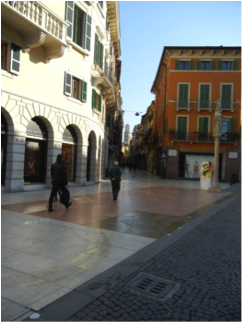
What a charming, enigmatic city Verona is…completely capable of making one reluctant to leave, if nothing else. I have to say that Verona is one of the most delightful cities that I have been to in Italy. Once you navigate in from the autostrada, (using the excellent directions that you printed out from your hotel), you can park the car and continue on foot from then until you leave. In the city center, everything is very close and easy to find.
  
We followed an excellent walking tour from Rick Steves and, as usual, he didn’t let us down. From the main Piazza Bra, to Juliet’s house and balcony, we never got lost, and we enjoyed our tour very much. Verona was once known as the “painted city,” for the paintings decorating the houses, and while much of that has faded, some remains. 

After we finished our tour, we got to rest for about an hour before dinner. We couldn’t decide where to go for dinner, so we consulted with Riccardo, the delightful and knowledgeable young man at the front desk at our hotel (great hotel, by the way…Hotel Torcolo).
  
He suggested we flip a coin to decide between the two restaurants in the running, so we did.  We went with the winner of the coin toss, Trattoria al Pompiere, and it was quite simply amazing. It may have been the best meal of our trip so far. It was a very friendly restaurant, with mostly Italians, which is always a good sign. At the back of the room 

where we were, there was a chef who did nothing but slice meats, organize them beautifully on a platter, and bring them personally to various  diners. There must have been at least 25 different salume to choose from, so we asked for a mixed platter for the table, making sure that one of the meats would be Proscuitto di Parma. I wish I would have taken a picture of that platter…it was beautiful. Charles picked a delicious Soave to have with the meats, and it complemented them perfectly. After that, Joan & I had Tagliatelle with Ragu (delicious), Bert had Fegato con cipolle (liver with onions…again, delicious), and Charles had a steak with roasted potatoes. We had a wonderful Valpolicella with our second course. And the best part was, we didn’t have to drive home! We did have a nice passagiata after dinner, though, and returned to our hotel, happy and full. As far as life beyond Verona’s walls…alas, there has to be, because tomorrow we must leave. Time to head to Venice!

Venice

After an early morning walk around Piazza Bra, we left Verona and headed for Venice. We decided to make two stops along the way: Vincenza, to see some structures built by Palladio and Padova, where we had decided to have lunch. Unfortunately, we had some difficulty parking in Vincenza, after having already had trouble finding the center of the city and, in frustration, we decided to skip Vincenza and just go straight to Padova for lunch. We will definitely try to get back to Vincenza, but maybe we’ll try to arrive by train next time…that might be a little easier.

We had a very nice lunch in Padova, then left for Venice. 


We arrived in Venice and, after much discussion, decided to park in Tronchetto, which is the slightly cheaper parking lot, and also one which allowed us to pick up the water taxi. In Venice, everything is done by boat, whether it’s delivering people or picking up trash (not that I’m comparing the two!). It’s really fascinating, seeing all of the services and goods delivered by all types of boats. The water taxi that we took was like a tour in itself, covering a large part of the Grand Canal before dropping us at St. Mark’s Square, which was the stop nearest to our hotel, the Hotel Diana. What a beautiful city Venice is…a true “feast for the eyes”!
  
No matter how many times I visit, Venice never fails to make me smile. We arrived about 3:30 p.m. on Tuesday, checked in, then went in search of a favorite glassmaker of Charles & Joan’s.  After successfully locating Vittorio and admiring his exquisite pieces, we decided to locate one of the many wine & cichetti bars of Venice to sample the local wines and a few appetizers. I chose a glass of Prosecco (no surprise there…I always choose Prosecco, if I have a chance). We also sampled a few interesting appetizers (potato cake, mushroom flan, artichokes, deep fried olives, deep fried meatballs, etc.). We were intending to make the chichetti our meal for the evening, but Bert wanted to sit down for his meal. 

We stumbled on a little ristorante and were reading the menu when the owner appeared and strongly suggested we come in. So we did. And we were very glad that we did! We weren’t really starving, and only wanted a little pasta, so three of us got the Spaghetti alla fruitta di mare. It was really delicious, served with lots of mussels, clams, and langoustines. Yummmm! Charles got the Fritto Misto, and that was delicious also. (Well, I think it was…he didn’t offer us any!) So that’s how it goes. Usually, you can eat well, even in a major tourist city like Venice, if you go off the beaten path a little and trust your instincts.
  
The next day we got up early and went to see some churches, especially La Salute, which is reached either by boat from St. Mark’s Square or by walking over the Accademia Bridge, which is what we did. That way, we got to wander while we were en-route to the church, never a bad thing to do in Venice. After reaching the church and admiring the inside (and taking fabulous pictures of St. Mark’s Square across the water), we found a café on the canal, where we could rest a bit and have something to drink. We decided on a bottle of Prosecco and, of course, it was delicious…or maybe the surroundings had something to with it.
  
Well, by this time, it was almost time for lunch, so we found a nice little trattoria, and enjoyed a simple, but delicious meal. I’ve heard that it’s difficult to eat well in Venice, and expensive, but I don’t agree. We were very happy with all of our meals in Venice, including the last one, which I’ll tell you about later.

After lunch, we split up, and Charles & Joan went off to do some shopping while Bert and I got lost trying to find St. Mark’s Square. We were a little frustrated and felt we were going around in circles, but eventually we found it! We took the taxi over to the see the church of San Giorgio Maggiore, designed by Palladio. There are also great views of Venice from there, and it's far from the maddening crowds around St. Mark’s Square. After taking the taxi back to St. Mark’s Square, we did a little shopping and rested up before dinner. 

So the question was, as always, “where to eat?” We thought we had a restaurant picked out, but the desk clerk at our hotel didn’t think it was O.K., plus it would have been about a 40 minute walk, which may have been difficult. So, she recommended Osteria alle Botta, near the Rialto Bridge.
  
It was really wonderful, not fancy, and just what we wanted. Bert & I both got a pasta dish (made in-house), and they were fantastic. Then Charles, Joan and Bert got a grilled fish (superb, fresh and perfectly cooked). We had a Soave to go with our meal, and that was perfect, too. I think we have new favorite restaurant in Venice!  As we strolled home from the restaurant, stopping by St. Mark’s Square once more to admire the moon over the city, we could almost imagine what it like here hundreds of years ago. One thing hasn’t changed: the magic that surrounds this city. That will be here, hopefully, for another hundred years, at least. Ciao!!

--Lynne